










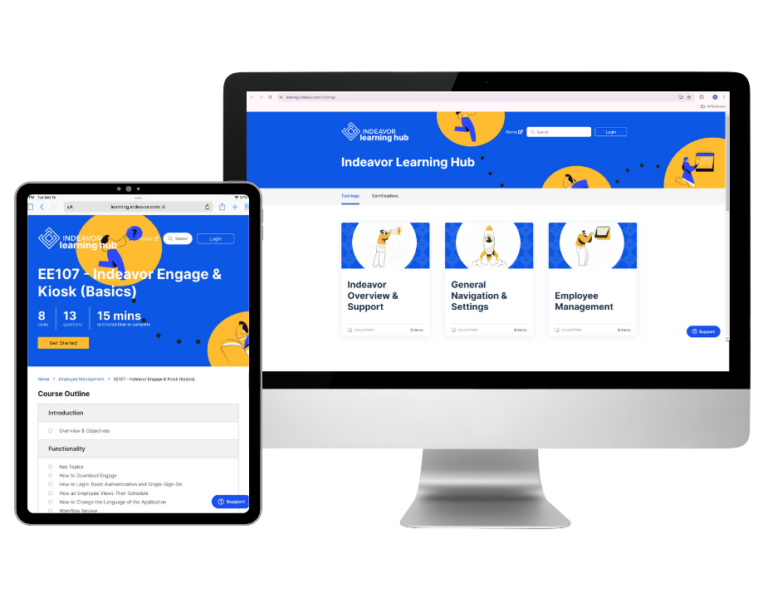

Automated Overtime Management Software.
Overtime premium, turnover, and recall exposure are all set at the same moment: when the schedule is built. Indeavor builds the schedule from your production plan, offers overtime by the contract instead of imposing it, and puts the right person in the right place at the right time, every single shift. We schedule what others can't.
"It used to take us 3 hours to plan forced OT — with our new forced OT system, it only takes 45 seconds!"
— Stacie Fischer, Operations Leader
Trusted by the world's most mission-critical enterprises
Rules enforced at scheduling. Not discovered at payroll.
Most tools report on overtime after it happens. Indeavor treats your overtime policy as a constraint the schedule has to satisfy before it can be published.
Automated overtime rule enforcement
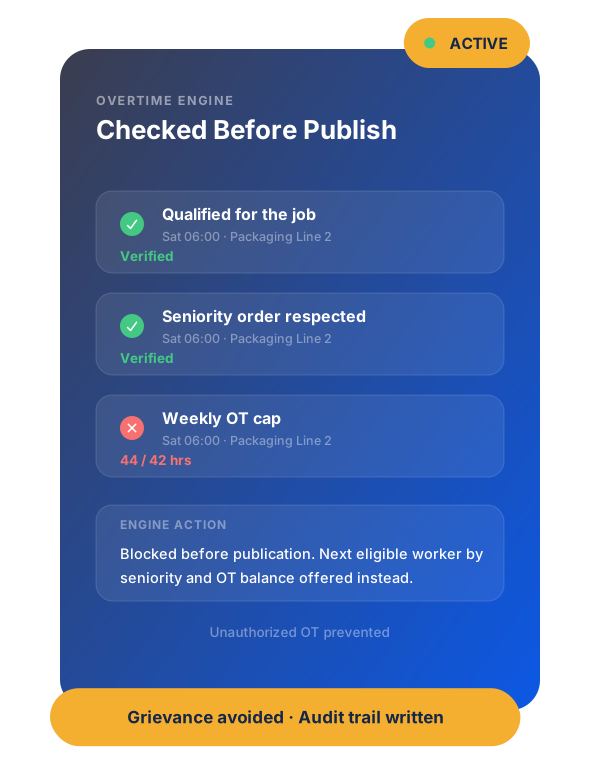
Shift approval is complex, and manually tracking hours and eligibility takes hours out of a supervisor's day. One missed rule is all it takes to trigger a grievance. Indeavor's scheduling engine enforces your overtime rules automatically, before a schedule is ever published.
- Eligibility by seniority, skill, and contract applied every time a shift is built
- Configurable caps and limits that block violations before publication, not after
- Real-time overtime impact visibility, so you know if an assignment triggers OT before you schedule or approve it
- Automated approval routing, so the right supervisor signs off without a chain of emails
Control labor costs and reduce overtime spend
Overtime is one of the largest and most volatile costs in frontline labor spend. Building the schedule against forecasted demand removes the reactive overtime that accumulates when coverage is solved one shift at a time. One Fortune 100 food and beverage site cut overtime hours in half on this approach.
- Demand-driven scheduling and labor forecasting that cut reliance on reactive overtime
- Visibility into overtime utilization by site, shift, or department
- Automatic enforcement of your documented overtime management policy
- One source of truth for overtime hours, rules, and equalization—replacing manual spreadsheets and whiteboards
Prevent grievances and stay audit-ready
In a unionized 24/7 operation, overtime is a labor-relations risk as much as a cost. Indeavor enforces seniority-based, contract-compliant distribution and keeps an auditable record of every assignment and approval, supporting the overtime management strategies your team already has in place.
- Seniority- and contract-compliant OT distribution enforced on every shift
- A complete audit trail for every overtime assignment and approval
- Built-in support for FLSA and state-level overtime rules
- Fewer disputes over who worked overtime and why
What does cutting overtime
actually look like?
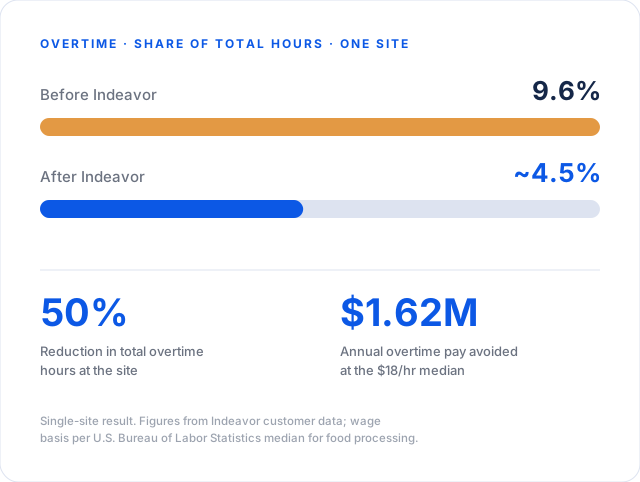
One of the world's largest food and beverage manufacturers implemented Indeavor at one of their global production sites. Total overtime fell roughly 50% — from about 10,000 hours per month to 5,000 — and overtime dropped from 9.6% of total hours worked to around 4.5%.
At the $18 median hourly wage the U.S. Bureau of Labor Statistics reports for food processing work, that is about $135,000 per month in overtime pay avoided — $1.62 million a year — at a single site. Across Indeavor's manufacturing customer base, the overtime rate has declined nearly 30% since early 2023.
Predictable labor cost. Quiet grievance queue.
Reported by customers running complex, often unionized, 24/7 operations. Results vary by site, agreement structure, and baseline scheduling practices.
Reduction in monthly overtime hours
Demand-driven scheduling instead of reactive coverage
Reduction in scheduling grievances
Contract rules applied consistently, every shift
Reduction in variable labor spend
Overtime planned rather than absorbed
Reclaimed per supervisor / week
Time back from manual tracking and approvals
Overtime gets decided
when the schedule is built.
Not when payroll runs.
An overtime management system that only reports is a system that tells you what you already spent. Because Indeavor enforces your rules at the point of assignment, the hours that would have breached a cap or skipped a name never get scheduled. Good overtime management is a scheduling decision, and this is where it gets made.
-
Demand sets the staffing level
Forecasted volume determines how many people each shift actually needs, so coverage is planned rather than patched. -
Eligibility is checked before the offer
Seniority order, qualifications, contract terms, and current OT balance decide who is in line for the extra hours. -
Caps block the assignment
An assignment that would breach a weekly cap or a fatigue limit cannot be published, so the violation never reaches the floor. -
Approval routes automatically
The right supervisor signs off in the system, and the decision plus its reasoning is written to the audit trail.

Real results from real operations.
"Indeavor Engage has been amazing for our employees and our supervisors. Engage has allowed our supervisors to post real time schedules and jobs for our employees — and for our employees to be able to see their scheduled shifts for the work week. We are looking forward to integrating our systems to continue eliminating our manual processes."
— Maegan Flora, Treehouse Foods
"Xcel Energy is thrilled to work with the specialists at Indeavor for our Worker Fatigue Management solution. Their expertise and dedication has helped create optimized employee schedules and has enabled Xcel's compliance with nuclear fatigue management regulations under 10 CFR Part 26. It has become a one-stop shop by streamlining internal workflows and combining different processes and applications, resulting in a lot of time saved across multiple work groups."
— John Truong, Xcel Energy
"I love the color coding and schedule view. The ease of scheduling employees is a time saver. The employees learned self service quickly and loved viewing their schedule and requesting time off."
— Allison S., Operations Manager
Frequently Asked Questions
Overtime management is the process of planning, tracking, and regulating the extra hours employees work past their normal schedules. Good overtime management keeps labor costs predictable, prevents worker burnout, and follows labor laws like the Fair Labor Standards Act (FLSA), which requires time-and-a-half pay for non-exempt workers after 40 hours in a week.
Unmanaged overtime drives up labor costs, increases the risk of union grievances and compliance violations, and contributes to employee burnout. For 24/7 operations, effective overtime management is often the difference between predictable labor costs and constant crises.
A strong overtime management system includes clear eligibility rules, defined caps and limits, a documented approval workflow, accurate pay calculation, reliable timekeeping, and an overtime policy that is communicated consistently to every employee.
Yes, mandatory overtime is legal in most cases. Under the FLSA, employers can require non-exempt employees to work overtime, provided the employees are paid time-and-a-half. As of a May 2026 technical amendment, the DOL formally restored the 2019 salary thresholds for white-collar overtime exemptions: $35,568 per year for most exempt employees and $107,432 per year for highly compensated employees. State laws and union contracts can add further restrictions, so confirm the specific rules that apply to your workforce and location.
The most effective approaches for reducing overtime costs include demand-driven scheduling, cross-training employees to reduce reliance on a small pool of overtime-eligible workers, automating approval workflows, and giving supervisors visibility into overtime as it accrues.
Common overtime management mistakes are tracking overtime manually or inconsistently, applying policy differently across shifts or supervisors, having no visibility into who is approaching an overtime threshold, and overlooking union seniority rules when assigning extra hours.
Indeavor enforces your overtime rules at the point of scheduling, checking eligibility, caps, and approvals before a schedule is ever published. It connects directly to Indeavor’s scheduling, absence management, and labor forecasting modules, so overtime decisions are based on the same data as the rest of your workforce plan.
Stop finding overtime on a report.
Decide it at the schedule.
Book a 30-minute live demo. See eligibility checks, caps,
approval routing, and the audit trail running against rules like yours.