










AUTOMOTIVE MANUFACTURING · AUTOMATED 24/7 SHIFT SCHEDULING
When the Line Changes, the Schedule Changes With it — Automatically.
Just-in-time production demands just-in-time scheduling — backed by a real-time versatility matrix. Indeavor automates workforce planning across rotating shifts, UAW rules, skill qualifications, training levels, and real-time production demand — so line supervisors run the line, not a spreadsheet.
"Indeavor Solutions provided me the best employee scheduling tool. It helped a lot while scheduling the various activities of employees. The best ever workforce management tool — it is very easy to handle and provides reliable management."
— Manufacturing Operations Leader
Trusted by the world's most mission-critical enterprises
Per minute of unplanned line downtime
Of automotive OT costs are unbudgeted
Reduction in overtime hours
Avg annual savings per 500-employee site
Why do scheduling errors cost so much in automotive manufacturing?
Because a line running on takt time has no buffer. One unqualified operator at a torque station, one unfilled absence, or one contract violation stops the line or ships a defect, and both are measured in minutes and warranty claims rather than administrative inconvenience.
The line doesn't stop for manual scheduling
In just-in-time manufacturing, a single understaffed position can halt production. At $22,000 per minute of unplanned downtime, you can't wait for a supervisor to manually work through a spreadsheet while the line sits idle. Demand changes by the hour. Your schedule needs to too.
One CBA shortcut becomes a grievance, then a work stoppage
Automotive UAW agreements are among the most complex in American labor — seniority rules, overtime distribution, job posting requirements, bumping rights. Under schedule pressure, one rule gets bent. A formal grievance follows. Then weeks of HR and legal time, and the morale damage that lingers.
The wrong tech on the wrong process is a quality escape
An uncertified worker assigned to welding, torque, or alignment isn't just an HR problem. It's a quality escape that may not surface until a vehicle is at the dealer. The direct cost is the recall. The reputational cost is harder to quantify.
Meet Danielle
Danielle works final assembly. She's 29, four years in, UAW. Her son is eight months old. Her husband works days at a distribution center, so childcare is a handoff: he's home by 4:30, she leaves at 4:45. There is no margin in that plan, and there is no second car.

What Danielle Wants
To know her shift assignment far enough ahead to arrange backup childcare. A way to trade a shift without finding someone in the parking lot. Overtime distributed by the contract, not by who happened to be standing closest to the supervisor. And to not be the last person to learn the line schedule changed. It isn't a lot to ask. But for most frontline workers in complex 24/7 operations, it isn't how the system works.
Things happen to you.
The line is adding Saturday production. Danielle hears it from a coworker. She has no childcare for Saturday.
Rotation moves her to second shift for two weeks. The posting went up Friday after she left. Her handoff no longer works.
Mandatory overtime, two hours. Her husband leaves work early to cover and loses the pay.
A junior tech got the Saturday overtime she was in line for. She files a grievance.
he grievance is upheld and she gets the make-up hours. She has already interviewed somewhere with a fixed shift.
You have a say.
Rotation, Saturday production, and line assignments are all in the app. Danielle arranges backup childcare once, for the whole month.
She needs Thursday off. She requests it in the app. The system checks coverage and contract rules and routes it. Approved that afternoon.
Overtime is needed. The system ranks the pool by seniority and overtime balance. Danielle’s turn comes when the contract says it does.
The change is sent to her phone the moment it’s published. She isn’t finding out in the parking lot.
There isn’t one. Every assignment carries a record showing which rule produced it.
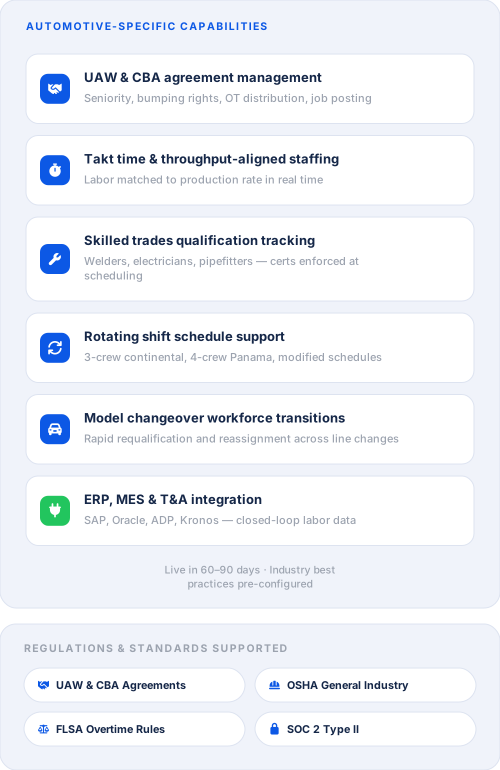
How does Indeavor handle takt time, UAW rules, and operator versatility?
Indeavor holds skills, training levels, and contract terms as rules, then applies them to every assignment before the schedule publishes. Production demand sets the staffing level, the versatility matrix decides who is eligible, and UAW provisions determine the order.
How does Indeavor build schedules around production demand?
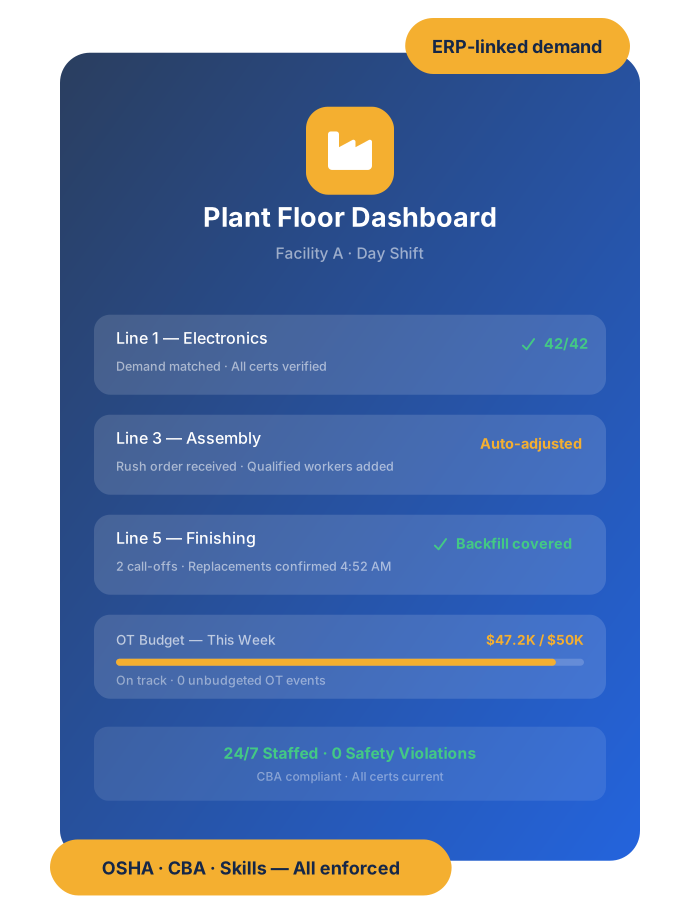
Indeavor ingests the production plan and builds staffing around actual line demand rather than a fixed template. Model mix changes, line additions, changeovers, and volume shifts are absorbed without rebuilding the schedule by hand.
- Takt time and throughput goals matched to staffing
- JIT and lean manufacturing scheduling logic built in
- ERP/MES integration for real-time demand signals
- Multi-line, multi-plant scheduling from a single system
How does Indeavor automate UAW and CBA compliance?
Every contract provision is configured once and applied to each scheduling decision — seniority, overtime equalization, shift preference rights, and callback procedures. Because the rule produces the assignment, each decision carries a record showing why it went the way it did.
- UAW and CBA rules enforced at every assignment
- Seniority and OT distribution automated
- 98% reduction in scheduling grievances
- Audit-ready records for every scheduling decision
How does the digital versatility matrix work?
Indeavor holds each operator's competency level, certifications, and training progress as the system of record for versatility. Assignments are checked against that matrix before they confirm, so an operator without the required qualification is not placed on a station that demands it.
- Customizable competency levels per role (baseline to expert)
- Certification and credential tracking with expiry management
- Real-time skill updates for training progress and availability
- Skill-gated scheduling prevents unqualified assignments automatically
Absence & Backfill Management
Unplanned absences trigger automated backfill — qualified replacement found, OT rules applied, line coverage maintained before the shift starts.
Employee Self-Service (Engage)
Line workers see their schedule, swap shifts, request PTO, and volunteer for OT — all from the Engage app. Fair, transparent, and compliant with UAW rules.
Dayforce Integration
Versatility data syncs bidirectionally with Dayforce for seamless HCM integration. Schedule changes, skills updates, and compliance data flow automatically — holistic workforce management without manual reconciliation.
What results do automotive manufacturers see?
Automotive customers report reduced unplanned overtime, fewer scheduling grievances, and supervisor hours returned to the floor each week. Results vary by plant, contract structure, and baseline scheduling practices.
Schedule automation rate
Even across rotating shifts and multi-line plants
Fewer scheduling grievances
CBA rules enforced consistently, every shift
Reduction in frontline attrition
Predictable, fair scheduling builds retention
What automotive scheduling complexity does Indeavor actually handle?
Generic HR tools approximate automotive scheduling. Indeavor was engineered for it — knowing the difference between takt time and cycle time, understanding how bumping rights work in a 3-crew rotation, and recognizing that a weld technician and a paint technician are not interchangeable.
-
Rotating shift patterns handled natively
3-crew continental, 4-crew Panama, alternating shifts, modified schedules — Indeavor handles the patterns automotive manufacturing actually uses, with all union constraints applied automatically. -
Model changeover workforce transitions
When a new model launches, thousands of workers need to be requalified and reassigned across lines. Indeavor manages the transition — who is qualified for what, who needs certification, and how the schedule restructures — without starting over from scratch. -
ERP-to-payroll data flow, closed-loop
Production demand signals flow in from your ERP. Optimized schedules flow out to T&A and payroll. No manual reconciliation, no data entry between systems. Your labor cost data is always current.
What do manufacturing customers say?
"It used to take us 3 hours to plan forced OT. With our new Forced OT SGM, it only takes us 45 seconds!"
— Stacie Fischer, Operations Leader
"I love the color coding and schedule view. The ease of scheduling employees is a time saver. The employees learned self service quickly and loved viewing their schedule and requesting time off."
— Allison S., Operations Leader
"Indeavor has become a one-stop shop by streamlining internal workflows and combining different processes and applications, resulting in a lot of time saved across multiple work groups."
— John Truong, Xcel Energy
See Indeavor configured for automotive manufacturing.
Book a 30-minute live demo — we'll show you demand-driven scheduling, UAW compliance, qualification enforcement, and takt time alignment running with real automotive data.
Frequently Asked Questions
Automated scheduling eliminates the manual work of creating and adjusting shift schedules — which typically consumes 10–15 hours of supervisor time per week in automotive plants. It also prevents the under- and over-allocation that drives unnecessary overtime and downtime. When production demand changes, the schedule adapts automatically, keeping labor aligned with takt time and throughput goals without a human scheduling cycle in between.
Indeavor encodes every clause of your collective bargaining agreements — seniority rules, overtime distribution, bumping rights, job posting requirements, rest periods — into the scheduling engine. These rules are checked automatically on every assignment, before it can be confirmed. Violations are blocked, not just flagged after the fact. Every scheduling decision is logged with a timestamp and rule reference, creating an immutable audit trail for grievance defense.
Yes. Indeavor integrates with SAP, Oracle, Ceridian Dayforce, ADP, Kronos, and other ERP, HCM, MES, and timekeeping systems through an API-first architecture. Production demand signals from your ERP drive scheduling decisions in Indeavor. Versatility data syncs bidirectionally with Dayforce for holistic workforce management. Finalized schedules and shift events flow back to T&A and payroll automatically — closing the loop from production plan to labor cost without manual data entry.
Indeavor provides real-time dashboards with labor performance against plant KPIs — overtime cost trends, headcount vs. production demand, absenteeism rates by line and shift, OT distribution equity, and scheduling efficiency metrics. These can be compared across multiple facilities to identify benchmarking opportunities and reallocate skilled labor where it’s most needed.
60–90 days for a full deployment — compared to the 12–18 months typical of horizontal HCM implementations. Indeavor ships with automotive manufacturing best practices pre-configured, including rotating shift patterns and common CBA structures. Configuration addresses your specific agreements, qualification profiles, and production rules. Services is not a profit center — our incentive is to get you live and generating results quickly.
A versatility matrix maps which operators are qualified to run which stations, and at what competency level. In Indeavor it is a live system of record rather than a spreadsheet: training progress and certifications update it, and the scheduling engine reads from it directly, so the matrix determines who is eligible for each assignment instead of documenting it after the fact.
Yes. Plants, lines, shifts, and crews are managed from one platform, with configuration that varies by site. Each location keeps its own contract terms, shift patterns, and station qualifications, while labor analytics roll up across the network for comparison.
Yes. Indeavor integrates with SAP, Oracle, Ceridian Dayforce, ADP, and other ERP, HCM, MES, and timekeeping systems through an API-first architecture. Production demand flows in from the ERP, and finalized schedules and shift events flow back to time and attendance and payroll.
Keep the line running.
Keep the schedule compliant. Automatically.
Union rules enforced, demand matched, qualifications verified — every shift,
across every line, without a supervisor spending Sunday night on a spreadsheet.