

Overtime laws govern how and when employers must compensate employees for hours worked beyond a standard threshold — and they vary more than most employers expect. While federal law establishes a consistent baseline, several states layer on additional protections around daily overtime, higher salary thresholds for exemptions, and stricter definitions of who qualifies. Failing to comply with the applicable overtime laws can expose employers to back pay, liquidated damages, civil penalties, and private lawsuits.
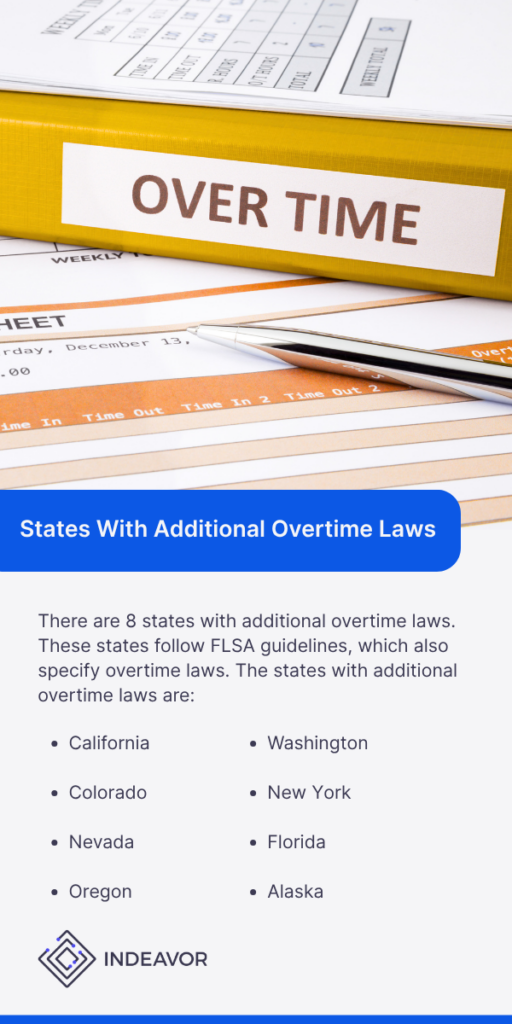
This article covers the federal overtime law framework, mandatory overtime, and the state-specific overtime pay laws that go beyond federal requirements — including the rules in California, Colorado, Nevada, Oregon, Washington, New York, Florida, and Texas. For multi-state employers managing complex shift schedules, understanding which rules apply where is a prerequisite to scheduling compliance.
Federal Overtime Law: What the FLSA Requires
The foundation of overtime law in the United States is the Fair Labor Standards Act (FLSA), first enacted in 1938. Under the federal overtime law, non-exempt employees must be paid at least 1.5 times their regular rate of pay for all hours worked over 40 in a defined workweek. A workweek is any fixed, regularly recurring period of 168 consecutive hours — seven 24-hour periods. Employers define their own workweek and must apply it consistently; it does not need to align with a calendar week.
The FLSA overtime threshold is per workweek — not per pay period, not per day. A non-exempt employee who works 30 hours in one week and 50 hours the next is owed overtime only for the 10 hours above 40 in the second week, even if their biweekly total is 80 hours. This is one of the most common overtime law misunderstandings for employers using biweekly or semimonthly pay periods.

Who Is Exempt from Federal Overtime Laws?
Not all employees are covered by the FLSA’s overtime requirements. Employees classified as exempt are not entitled to overtime pay. Under current federal overtime rules, an employee is generally exempt from overtime laws if they meet both a salary basis test and a duties test:
- Salary threshold: The employee must earn at least $684 per week ($35,568 annually) on a salary or fee basis. Note that several states — including California, Washington, New York, and Colorado — have set higher salary thresholds, meaning more employees qualify for overtime protection in those states than under federal law alone.
- Duties test: The employee must primarily perform executive (managing a department or team), administrative (office/non-manual work directly related to management), or professional (requiring advanced knowledge or a creative field) duties. Highly compensated employees earning over $107,432 annually face a reduced duties test.
When in doubt, the employee is non-exempt and covered by fair labor law overtime protections. Misclassification is one of the most frequently cited wage violations — and the remedy includes back wages, liquidated damages, and attorney fees.
Is Mandatory Overtime Legal?
Under federal law, mandatory overtime is legal for most employees. The FLSA does not limit the number of hours an employer can require a non-exempt adult employee to work — it only requires that overtime hours be compensated at the 1.5× rate. Refusing to work required overtime can be grounds for discipline or termination under federal law.
The exceptions are narrow. Some state mandatory overtime laws impose restrictions for specific industries — most notably healthcare, where nurses and certain other clinical staff in states including California, Oregon, Washington, and New York have protections against being mandated to work beyond certain shift lengths. Mandatory overtime restrictions also appear frequently in collective bargaining agreements for manufacturing and industrial workers. Outside of these carve-outs, mandatory overtime is legal and widely practiced in industrial operations, logistics, and healthcare.
There is no federal law requiring that employers give advance notice before requiring mandatory overtime. Notice requirements exist in some states under predictive scheduling laws (currently in effect in Oregon, Chicago, New York City, Philadelphia, San Francisco, and Seattle), but these apply to schedule changes broadly, not mandatory overtime specifically. Employers should consult state and local law — and any applicable CBA — for notice obligations before implementing mandatory overtime policies.
States with daily overtime thresholds beyond the federal 40-hrs/week standard:
| State | Daily OT threshold | Rate | Notes |
| Alaska | Over 8 hrs/day | 1.5× | In addition to 40 hrs/week weekly threshold |
| California | Over 8 hrs/day; over 12 hrs/day | 1.5× then 2× | Also 1.5× for first 8 hrs on 7th consecutive day; 2× after 8 hrs on 7th day. Only state with mandatory double time. |
| Colorado | Over 12 hrs/day or 12 consecutive hrs | 1.5× | Weekly 40-hr threshold also applies; whichever produces higher pay governs. |
| Nevada | Over 8 hrs/day (lower-wage workers only) | 1.5× | Applies only to employees earning less than 1.5× the state minimum wage. |
| Oregon | Over 10 hrs/day (manufacturing only) | 1.5× | Daily overtime applies specifically to mill, factory, and manufacturing establishments. |
| Kentucky | 7th consecutive day of work | 1.5× | Overtime required on the 7th consecutive day of work in a workweek, regardless of total weekly hours. |
Overtime Pay Laws by State
Most states follow the federal 40-hour weekly threshold and 1.5× rate without modification. However, several states with significant employer populations have enacted overtime pay laws that go further — through daily overtime triggers, higher salary thresholds for exemptions, or industry-specific rules. Below is a summary of the overtime laws in the states where the rules differ most from federal law.
Overtime Laws in California
California overtime law is the most employee-protective in the country and applies on top of, not instead of, federal law. Under California overtime law, non-exempt employees are entitled to:
- 1.5× their regular rate for hours over 8 in a single workday
- 1.5× for hours over 40 in a workweek
- 1.5× for the first 8 hours worked on the 7th consecutive day in a workweek
- 2× (double time) for hours over 12 in a single workday
- 2× for hours over 8 on the 7th consecutive day in a workweek
California is the only U.S. state that mandates double-time pay. The law on overtime pay in California also applies a higher salary exemption threshold — $1,320 per week ($68,640 annually) as of January 1, 2026 — meaning many employees who would be exempt under federal overtime laws remain entitled to overtime under California law. Employers must apply whichever calculation produces the higher pay.
Overtime Laws in Colorado
Under Colorado overtime law, employers must pay 1.5× for hours worked beyond:
- 40 hours in a workweek
- 12 hours in a single workday
- 12 consecutive hours, without regard to the start and end time of the workday (excluding duty-free meal periods)
Colorado overtime laws also set the exempt salary threshold at $1,057.69 per week ($55,000 annually) as of January 1, 2026, well above the federal floor. Colorado’s Overtime and Minimum Pay Standards (COMPS) Order governs most private employers and includes specific rules for agricultural workers, tipped employees, and certain seasonal industries.
Overtime Laws in Nevada
Nevada overtime laws create a two-tier system based on wage level. Employees earning less than 1.5 times the state minimum wage per hour are entitled to overtime pay after 8 hours in a single workday, in addition to the standard 40-hour weekly threshold. Employees earning at or above that threshold are subject only to the federal weekly standard. This provision is specifically designed to protect lower-wage workers from long single-day shifts without premium pay.
Overtime Laws in Oregon
Under Oregon overtime law, employees in manufacturing establishments, mills, canneries, and factories are entitled to overtime at 1.5× after 10 hours in a single workday, in addition to the standard 40-hour weekly threshold. This Oregon overtime law provision applies specifically to industrial and manufacturing employers. Oregon also enforces statewide predictive scheduling requirements (Oregon FAIR Work Week Act), which creates additional obligations around schedule changes and mandatory overtime notice for retail, hospitality, and food service employers with 500+ employees.
Overtime Laws in Washington
Washington overtime laws follow the federal 40-hour weekly threshold and 1.5× rate, but set a significantly higher salary exemption threshold. Employees must earn at least $1,332.80 per week ($69,305.60 annually) as of January 1, 2026, to qualify as exempt under Washington state law — more than double the federal threshold. This makes Washington one of the states where the most salaried employees remain eligible for overtime law protections. Healthcare workers in Washington also have specific mandatory overtime protections through the Washington Nurse Staffing Standards law.
Overtime Laws in New York
New York overtime laws follow the federal 40-hour weekly standard, but apply a higher salary exemption threshold. As of January 1, 2026, the threshold is $1,237.50 per week ($64,350 annually) in New York City, Long Island, and Westchester County, and $1,161.65 per week ($60,405.80 annually) in the rest of the state. Under NYC overtime law, the Fair Workweek Law also imposes advance scheduling and premium pay requirements for retail and fast food employers with 10+ locations globally — overlapping with mandatory overtime obligations for those industries.
Overtime Laws in Florida
Florida overtime law follows federal law without additional state-level modifications for most private-sector employees. Non-exempt employees are entitled to 1.5× after 40 hours in a workweek under the federal standard. Florida overtime law does include a provision for manual laborers under a separate statute: employers may not require manual laborers to work more than 10 hours in a day without additional compensation, unless the employee and employer have a written contract specifying a different arrangement. Florida has no daily overtime rule for non-manual workers. There is no state-specific overtime law agency; enforcement runs through the federal DOL.
Overtime Laws in Texas
Texas overtime law mirrors the federal FLSA standard: non-exempt employees are entitled to 1.5× for hours over 40 in a workweek. Texas has no daily overtime rule, no state-specific salary exemption threshold above the federal level, and no predictive scheduling laws. Mandatory overtime is legal in Texas, and there are no state-level restrictions on the number of hours an adult private-sector employee may be required to work. The Texas Workforce Commission enforces Texas overtime law in addition to the federal DOL.
Overtime Laws in Alaska
Alaska requires overtime at 1.5× for hours worked over 8 in a single workday in addition to the standard 40-hour weekly threshold. This daily overtime rule applies broadly to most non-exempt employees and means that an employee working two 10-hour days can already owe 4 hours of overtime before reaching the weekly threshold. Alaska overtime laws also require overtime on the first day off when an employer requires work on a scheduled day off.
Managing Overtime at Scale
With overtime laws varying by state and daily overtime rules adding complexity for multi-shift operations, managing compliance manually is difficult at scale. Indeavor’s compliance management and employee scheduling platform enforces overtime rules by employee, location, and applicable state law — automatically flagging thresholds before they’re crossed and giving your workforce analytics team real-time visibility into overtime exposure. Our absence management tools also help model the downstream overtime impact of call-offs before they hit the schedule.
Learn more about how Indeavor helps manufacturing and industrial employers manage labor compliance, or book a demo to see the platform in action.
Frequently Asked Questions (FAQs)
How much notice is required for mandatory overtime?
Federal law imposes no advance notice requirement for mandatory overtime. State predictive scheduling laws in Oregon, Chicago, New York City, Philadelphia, San Francisco, and Seattle require advance notice for schedule changes but are generally limited to specific industries (retail, hospitality, food service). Collective bargaining agreements frequently include mandatory overtime notice requirements regardless of state law.
What is the new 32-hour overtime law?
As of August 2026, there is no enacted federal 32-hour workweek law. Several legislative proposals have been introduced in Congress to reduce the overtime trigger from 40 hours to 32 hours per week, which would significantly expand overtime eligibility, but none have passed into law. Employers should monitor legislative developments, as any such change would have significant payroll and scheduling implications. Use Indeavor’s overtime calculator to model the impact of threshold changes on your operation.
What is the new overtime rule?
The most recent significant change to federal overtime laws was the DOL’s 2024 final rule that raised the standard salary exemption threshold from $684/week ($35,568/year) to $844/week ($43,888/year) effective July 1, 2024, and to $1,128/week ($58,656/year) effective January 1, 2025. This rule expanded fair labor law overtime coverage to millions of previously exempt salaried workers. However, the rule faced legal challenges and was vacated by a federal court in November 2024, reverting the threshold to $684/week. As of mid-2026, the salary threshold remains at $684/week pending further DOL rulemaking or litigation resolution. Employers should verify the current effective threshold before making exemption determinations.
Is 60 hours in 2 weeks overtime?
Under federal overtime laws and most state laws, no. Overtime is calculated per workweek, not per pay period. An employee who works 20 hours one week and 40 hours the next has worked 60 hours in two weeks but owes no overtime under federal law, because neither week exceeds 40 hours. If they worked 30 hours one week and 30 the next, the same result. Only hours above 40 in a single defined workweek trigger the 1.5× overtime requirement under the FLSA. In states with daily overtime rules (California, Alaska, Colorado, Nevada, Oregon), daily thresholds apply on top of weekly calculations.
Is it against the law to not pay overtime?
Yes. Failure to pay overtime wages required by the FLSA or applicable state overtime laws is a wage violation. Employers who fail to pay mandatory overtime can be held liable for back wages owed, an equal amount in liquidated (penalty) damages, court costs, and attorney fees. The DOL can investigate and recover back wages administratively, and employees can also file private lawsuits. Willful violations can result in criminal prosecution. There is a two-year statute of limitations for non-willful FLSA violations and three years for willful violations. State overtime pay laws often provide longer limitation periods and additional remedies.
About the Author
Severin Studer is the Revenue Operations Lead for Indeavor. He identifies opportunities to streamline and improve the customer lifecycle, go-to-market strategies, and sales process. He works cross-functionally with departments and stakeholders to share insights, centralize information, and report on various KPIs. To learn more or get in touch, connect with Severin on LinkedIn.