




LIFE SCIENCES · AUTOMATED 24/7 FRONTLINE SHIFT SCHEDULING
In Life Sciences, Your Scheduling Records are FDA Records. Get them right.
Indeavor enforces GxP qualification requirements at every assignment, builds 21 CFR Part 11–ready audit documentation automatically, and keeps your workforce in compliance with FDA, EMA, and GMP requirements — so inspections reveal best practices, not findings.
"Indeavor helps labs maintain compliance through automated scheduling that ensures skilled workers are assigned to tasks, reducing safety risks and adhering to industry regulations — with detailed audit trails of scheduling decisions and worker skills matrices applied during task assignments."
— Indeavor Life Sciences Implementation Team
Trusted by the world's most mission-critical enterprises
Avg cost of FDA consent decree enforcement action
Of pharma workers report production scheduling challenges
GxP qualification compliance, every assignment
Avg annual savings per 500-employee facility
Why is scheduling part of your quality system in GxP environments?
Because who performed an operation, and whether they were qualified at that moment, is a quality record. If scheduling lives outside the quality system, every batch review becomes a reconstruction exercise and every qualification lapse is discovered after the work is already done.
FDA investigators ask: "Who was qualified for this step?" You need to answer instantly
When an FDA investigator reviews a deviation or conducts a routine inspection, they ask who was assigned to each critical step, what their training records showed, and when their qualification was last renewed. Manual scheduling tracked in spreadsheets cannot answer these questions reliably, instantly, or with the documentation integrity 21 CFR Part 211 requires. That gap is a Form 483 observation before anything went wrong.
An expired training record is a regulatory finding — even if the batch was perfect
In 21 CFR Part 211 environments, training records are regulatory documentation. An operator whose GMP training has lapsed but was scheduled to perform a critical step creates an audit finding regardless of product quality. Manual credential tracking misses expirations. One oversight creates a CAPA, a deviation report, and potentially a warning letter — all traceable to a single scheduling decision.
Pharma production runs on batch timelines, not shift patterns — manual scheduling can't flex fast enough
Clinical trial ramp-ups, tech transfers, validation batches, commercial launch spikes, and CMO contract variability drive staffing demand that bears no resemblance to a fixed shift template. Manual scheduling produces chronic over- and under-staffing against batch demand — either stalling production or bleeding overtime on idle capacity.
Meet Hana
Hana is a sterile fill technician at a biologics plant. She's 31, six years in a cleanroom, and since her mother's stroke she's the one who drives her to physical therapy on Tuesdays and Fridays. Her gowning qualification and aseptic certifications are what let her work in the suite at all. Both of those facts govern her week.

What Hana wants
A schedule she can plan therapy appointments around. Certifications tracked by the system instead of by her own calendar reminders. Assignments that match what she's actually qualified for. And a way to request time off that doesn't depend on catching her supervisor between batches. It isn't a lot to ask. But for most frontline workers in complex 24/7 operations, it isn't how the system works.
Things happen to you.
The batch schedule changes and Hana’s shift moves. She reschedules her mother’s Tuesday therapy for the third time this quarter.e.
Her aseptic requalification is coming due. She knows because she wrote it on a sticky note.
She’s assigned to a suite requiring a qualification that lapsed nine days ago. It’s caught at the gowning room. The batch start is delayed.
She requests two hours off for therapy. Her supervisor is in a deviation meeting. She misses the appointment.
Quality asks for training records tied to the batch. Someone spends two days assembling them out of three systems.
You have a say.
Hana’s schedule is in the app, including batch-driven changes as they’re published. She books therapy against it once.
Her aseptic and gowning qualifications are in the system, and expiration dates block scheduling past the validity period. Requalification gets scheduled before it becomes a problem.
The system checks qualifications before confirming an assignment. Nobody walks to the gowning room and gets turned around.
She requests Tuesday afternoon in the app. The system checks coverage and routes it. Approved without cornering anyone in a hallway.
Training and qualification records are pulled from captured scheduling data. Two days becomes a report.
How does Indeavor support GMP, GLP, and 21 CFR Part 11 requirements?
Indeavor checks GxP qualifications before confirming any assignment, blocks scheduling past a qualification's validity period, and retains a timestamped record of each decision and the rule that produced it — the evidence an inspector asks for.
How does Indeavor enforce GxP qualifications at every assignment?
Indeavor checks each technician's GMP training, aseptic and gowning qualifications, and role-specific certifications before an assignment is confirmed. Expiration dates block scheduling past the validity period, so a lapsed qualification is caught during planning rather than at the suite door.
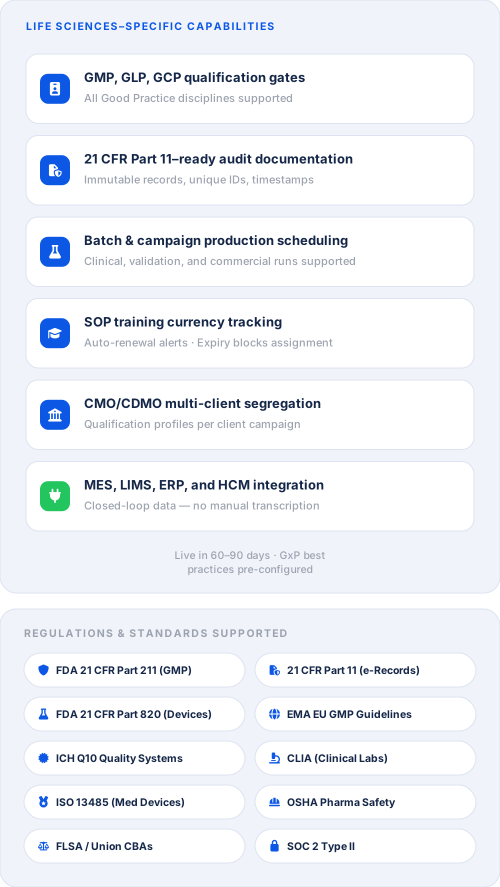
- GMP, GLP, and GCP qualification gates enforced
- SOP training currency verified per step
- Expired certifications block assignment automatically
- Role-specific competency matrices applied at scheduling
How does Indeavor support 21 CFR Part 11 audit documentation?
Every scheduling decision is recorded with a timestamp, the person assigned, their qualifications at that moment, and the rule that produced the assignment. Records are pulled from captured scheduling data, so inspection and batch review evidence does not have to be reconstructed from separate systems.
- Immutable, timestamped audit trail per assignment
- Batch record–ready scheduling documentation
- FDA and EMA inspection-ready instantly
- CAPA and deviation investigation support
How does Indeavor schedule around batch and project demand?
Indeavor builds staffing from the batch schedule and project plan rather than a fixed shift template. Campaign changes, batch delays, and validation activity shift the labor requirement, and the schedule is rebuilt against qualification rules automatically.
- Production campaign and batch timeline scheduling
- Validation run and tech transfer workforce planning
- CMO/CDMO multi-client demand management
- MES and ERP integration for real-time demand signals
Training Record & Renewal Management
Certification expiry tracked across all staff with automated alerts 60–90 days before expiration. Qualification gaps flagged before they become scheduling constraints — or FDA findings.
Multi-Site Pharmaceutical Network
Multiple manufacturing sites, R&D facilities, and clinical operations — coordinated from a single platform. Consistent GxP compliance rules applied across every facility in your network.
Employee Self-Service (Engage)
Scientists, technicians, and operators see their schedule, request time off, and swap shifts — within GxP compliance constraints. Qualification gates apply to every employee action.
What results do life sciences manufacturers see?
Regulated labs report fewer qualification-related delays, faster batch record and inspection response, and less supervisor time spent assembling training evidence. Results vary by site, sub-sector, and existing quality systems.
Reduction in overtime hours
Batch-demand matching eliminates excess labor
Audit trail completeness
Every decision documented · FDA inspection-ready
Schedule automation rate
Across labs and research facilities
Is your scheduling system prepared for an FDA inspection?
Most life sciences organizations don’t think of their scheduling system as a GxP system — until an FDA investigator asks who was qualified for a particular batch step and they can’t answer cleanly. Indeavor is designed to be part of your quality infrastructure: documented, validated, and capable of answering any inspection question about workforce deployment instantly.
-
Audit trails that meet 21 CFR Part 11 requirements
Indeavor's scheduling records include the required elements for 21 CFR Part 11 electronic records: unique user identities, accurate timestamps, sequential event documentation, and protection against alteration. Every scheduling action is captured in an immutable log that can be produced instantly for inspection. -
CMO / CDMO multi-client complexity managed
Contract manufacturing organizations run multiple client campaigns simultaneously — each with different GMP requirements, qualification profiles, and production timelines. Indeavor manages qualification segregation per client and campaign, ensuring that only personnel qualified for a specific client's requirements are scheduled to their production lines. -
MES and LIMS integration — closed-loop data
Production demand signals from your MES flow into Indeavor. Finalized scheduling and qualification data flow back to your batch records and LIMS. No manual transcription between systems — the data integrity that GxP requires is built into the integration architecture.
Which life sciences sub-sectors does Indeavor support?
Pharmaceutical Mfg
21 CFR Part 211 GMP, batch record support, sterile and non-sterile operations, campaign scheduling.
Biotech
Biologics manufacturing, cell and gene therapy, tech transfer phases, clinical to commercial transitions.
Medical Devices
21 CFR Part 820 / ISO 13485 QSR, design control staffing, sterilization process qualification.
Lab Research
GLP-compliant staffing, full audit trail of who was in the lab and when, equipment access coordination, credentialed technician coverage.
CMO / CDMO
Multi-client campaign management, per-client qualification segregation, flexible batch-driven staffing for contract variability.
Clinical & Diagnostic Labs
CLIA compliance, lab scientist credential tracking, shift coverage for 24/7 testing operations, GLP environments.
What do life sciences customers say?
"It used to take us 3 hours to plan forced OT. With our new Forced OT SGM, it only takes us 45 seconds!"
— Stacie Fischer, Operations Leader
"I love the color coding and schedule view. The ease of scheduling employees is a time saver. The employees learned self service quickly and loved viewing their schedule and requesting time off."
— Allison S., Operations Leader
See Indeavor configured for life sciences.
Book a 30-minute live demo — GxP qualification enforcement, 21 CFR Part 11 documentation, batch-driven scheduling, and training record tracking running with real GMP data.
Frequently Asked Questions
Indeavor’s scheduling records include the core elements required for 21 CFR Part 11 electronic record integrity: unique user identification for every action, accurate and secure timestamps, sequential audit trail entries that cannot be altered retroactively, and records that are readily retrievable for inspection. Every scheduling decision — who was assigned, when, which rule governed the decision, and what their qualifications were — is captured in an immutable log that can be produced for an FDA investigator or regulatory auditor on demand.
Each manufacturing step, lab function, or critical operation is assigned a qualification profile in Indeavor — specifying required GMP level, SOP training completion, competency assessments, and any role-specific certifications. When a scheduling assignment is created, Indeavor checks the assigned employee’s credentials against that profile in real time. If any required qualification is missing, expired, or not documented, the assignment is blocked before it can be confirmed. The system does not allow a workaround — the qualification must be current and documented.
Contract manufacturing organizations run multiple client campaigns simultaneously — each with distinct GMP requirements, qualification profiles, and production timelines. Indeavor supports per-client qualification segregation: employees can be qualified for one client’s processes and not another’s, with those distinctions enforced at scheduling. Campaign scheduling manages multiple concurrent batch timelines with different staffing profiles, and audit trails are maintained per campaign for client-specific regulatory documentation.
Yes. Indeavor integrates with manufacturing execution systems (MES), laboratory information management systems (LIMS), and ERP platforms through an API-first architecture. Production batch demand flows from your MES into Indeavor to drive scheduling decisions. Qualification and staffing data from Indeavor can flow back to support batch records and regulatory documentation. Payroll and HR data flows to and from HCM systems — creating a closed-loop that eliminates manual transcription and the data integrity risks it creates in GxP environments.
Indeavor deploys in 60–90 days for a fully configured life sciences implementation — significantly faster than horizontal HCM platforms that require extensive custom development for GxP compliance. Life sciences manufacturing best practices are pre-configured: GMP qualification frameworks, training record structures, and audit trail formats. Configuration addresses your specific SOPs, qualification matrices, and facility rules without starting from scratch.
GxP-compliant workforce scheduling treats the schedule as a controlled quality record. Qualifications are verified before an assignment is confirmed rather than audited afterward, expired training blocks scheduling, and every decision retains a timestamped record of who was assigned, what they were qualified for, and which rule produced the outcome.
ach role carries a qualification profile that you define and maintain, covering GMP training, aseptic and gowning qualifications, and equipment-specific certifications. Expiration dates prevent scheduling beyond the validity period, and qualification status is visible in the skills matrix so requalification can be planned before it interrupts production.
Every qualification verified. Every record
audit-ready. Built in, not assembled later.
The scheduling system that answers any FDA inspector’s question
— who was qualified for this step, when, and why they were
assigned — instantly, automatically, every batch.