




HEALTHCARE · AUTOMATED 24/7 FRONTLINE SHIFT SCHEDULING
Staffing Decisions in Healthcare are Patient Safety Decisions.
Indeavor automates healthcare workforce scheduling around patient acuity, mandatory staffing ratios, credential requirements, and fatigue limits — so nurses stay, burnout falls, travel labor costs drop, and care quality rises.
"The platform saves time by automating scheduling calculations and reduces the risk of errors. It also saves money by eliminating excess labor costs and unnecessary overtime."
— Healthcare Operations Leader
Trusted by the world's most mission-critical enterprises
Annual RN turnover rate at U.S. hospitals
Higher cost of travel nurse vs. permanent staff
Reduction in frontline attrition
Reduction in overtime hours
Why do burnout, agency costs, and credential gaps trace back to the schedule?
The schedule decides how many consecutive shifts a nurse works, whether a unit meets ratio without calling an agency, and whether an expired license reaches the bedside. Fatigued nurses make more errors and leave sooner, and each departure costs $40K–$80K to replace.
Understaffed units don't just miss targets — they miss patients
When a medical-surgical floor is down two nurses on nights, the remaining staff carries an unsafe patient load. Research consistently links inadequate staffing ratios to higher medication error rates, slower response to deterioration, and worse patient outcomes. CMS Conditions of Participation and Joint Commission standards require adequate staffing. Manual scheduling fails this requirement repeatedly.
Travel nurses cost 3× permanent staff — and they're a symptom of burnout, not a solution
Every RN who leaves costs $40,000–$80,000 to replace. Travel nurses fill the gap at 3× the cost of permanent staff — while permanent nurses watch outsiders command premium pay for the same work, deepening the resentment that drives the next departure. Breaking the cycle requires scheduling that's predictable, fair, and doesn't routinely force mandatory overtime.
An expired credential creates instant regulatory and liability exposure
An RN whose state license has lapsed, a tech with an expired BLS certification, a float pool nurse without required unit-specific competencies — any creates immediate Joint Commission, CMS, and malpractice liability exposure. Manual credential tracking in spreadsheets misses expirations. One audit finding from a licensing board changes that tolerance to zero.
Meet Priya
Priya is an ICU nurse. She's 34, eight years at the bedside, and a single parent to a five-year-old. Daycare closes at 6:00 and charges by the minute after that. She is good at this job. She would like to still be doing it in ten years.

What Priya Wants
A schedule far enough ahead to arrange childcare. Assurance that her unit is staffed to ratio so she isn't carrying an unsafe assignment. Real rest between shifts. A way to pick up an extra shift when she wants the money, and to say no when she doesn't. It isn't a lot to ask. But for most frontline workers in complex 24/7 operations, it isn't how the system works.
Things happen to you.
The schedule drops. Three twelves in a row ending on a night. Daycare doesn’t cover nights.
A colleague calls off. The unit runs under ratio. Priya takes an extra patient, documents it, and hopes.
She’s asked to stay. Daycare closes in twenty minutes. She says no and spends the drive home feeling like she let the unit down.
Her BLS renewal lapsed, and nobody caught it. She finds out when she’s pulled from an assignment mid-shift.
A travel agency recruiter texts her. It isn’t the job she fell in love with, but it’s double the rate and a schedule she picks. This time she reads the whole message.
You have a say.
Priya’s schedule is in the app. Daycare still doesn’t cover nights, but she can see which ones are coming early enough to line up her sister for two of them and swap the third through the app.
Ratios are built into the schedule as a hard rule. The schedule can’t publish under ratio, so she isn’t discovering the gap at handoff.
Maximum shift length and minimum rest are enforced. She isn’t scheduled into a turnaround that leaves her seven hours to sleep, commute, and get her son to daycare.
Her BLS expiration is visible to her in the app. She can see it coming with weeks to spare and books the renewal herself, before it ever touches a shift.
Open shifts show in the app. She picks up two before her son’s birthday and skips the rest.
How does Indeavor handle nurse ratios and complex clinical staffing rules?
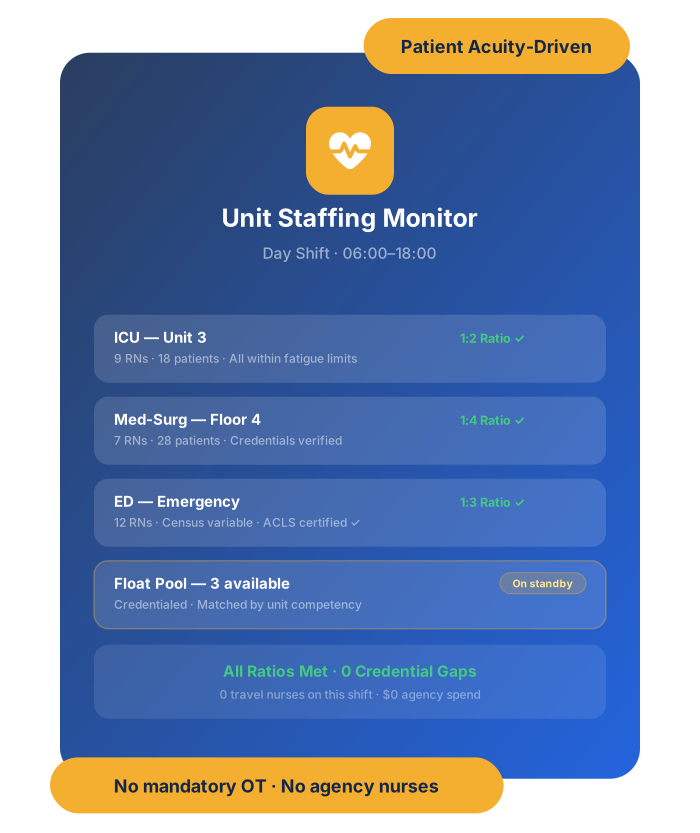
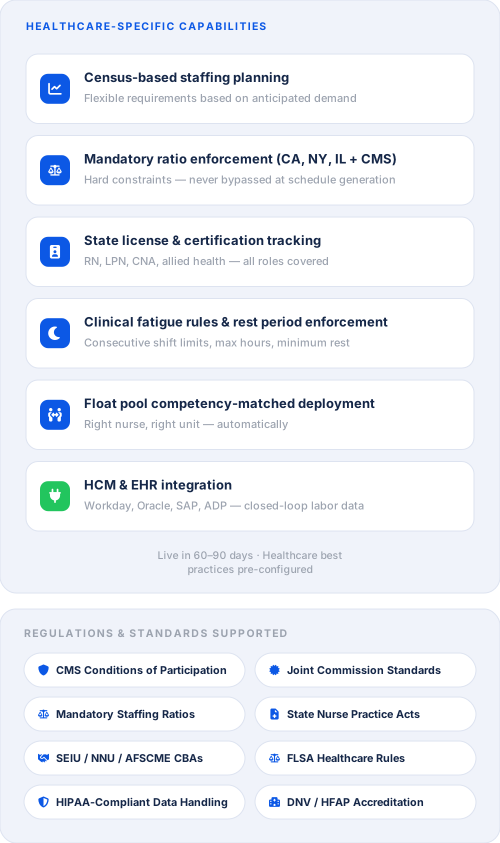
Indeavor encodes mandatory ratios as hard constraints, so a schedule cannot be published without meeting them for every unit and every shift. Credential requirements, fatigue limits, and anticipated absences are applied at the same time, across every unit and modality.
How does Indeavor enforce mandatory nurse-to-patient ratios?
Indeavor encodes minimum staffing requirements as hard constraints — the schedule cannot be published without meeting ratio mandates for every unit and every shift. Ratios such as 1:2 ICU and 1:4 Med-Surg, plus state-specific requirements, are applied during schedule generation alongside current census and anticipated absences.
- Staffing ratios enforced — never bypassed
- Flexible staffing based on census assumptions
- Float pool matched by unit competency
- Automated backfill before the shift starts
How does credential and license tracking work for clinical staff?
Indeavor checks credentials against assignment requirements before confirming any shift. Every role — RN, LPN, CNA, RT, allied health — has a credential profile that you define and maintain. Expiration dates prevent scheduling beyond the credential's validity period, and credential status is visible in the skills matrix for audit and compliance purposes.
- Expired credentials block assignment automatically
- License, BLS/ACLS, and competencies tracked per clinician
- Credential status visible in skills matrix
- Joint Commission and CMS audit-ready records
How does Indeavor manage fatigue for clinical staff?
Indeavor enforces maximum shift lengths, consecutive day limits, minimum rest periods, and weekend fairness rules. Research links extended shift hours and consecutive shift sequences to measurably higher adverse event rates, so these limits protect patients while preventing the burnout that drives resignations.
- Max shift length and consecutive shift limits enforced
- Minimum rest period between shifts required
- Weekend and holiday fairness automated
- Mandatory OT alerts before assignment confirmed
Union CBA Compliance (SEIU, NNU, AFSCME)
Healthcare unions are growing and active. Indeavor encodes seniority rules, OT distribution, shift bidding rights, and callback procedures — enforced automatically, grievance-proof.
Clinician Self-Service (Engage)
Nurses see their schedule, swap shifts compliantly, request PTO, and volunteer for open shifts — from the Engage app. A direct driver of the attrition reduction in clinical settings.
Multi-Facility & Multi-Unit Analytics
OT cost trends, credential gap analysis, ratio compliance by unit, agency vs. permanent labor spend — across your entire system. Identify high-risk units before adverse events document them.
What results do healthcare organizations see?
Healthcare customers report a 90% reduction of temp labor, 99% credential compliance every shift, and roughly $450K in average annual savings per 500-staff facility. Results vary by facility size, modality, and baseline practices.
Reduction of temp labor
Align resource allocation with demand
Credential compliance, every shift
Expired licenses blocked before assignment
Avg annual savings per 500-staff facility
Labor cost reduction from automation
How does nurse scheduling affect
patient safety and retention?
The connection is direct: fatigued, burned-out nurses make more errors. Nurses who feel their schedule is unpredictable, unfair, or overloaded leave — and are replaced at $40K–$80K apiece, often with travel nurses who cost 3× more and don’t know the unit. Fixing scheduling simultaneously addresses retention, safety, and labor cost.
-
Predictable schedules are a retention strategy
When nurses can plan their personal lives around a schedule they see in advance, can swap shifts through a fair process, and see OT distributed equitably — they stay. Schedule predictability consistently ranks among the top reasons nurses cite when choosing to leave or remain at a facility. -
Mandatory ratios enforced before the first shift is published
State mandatory staffing ratio laws (California, New York, Illinois) and CMS Conditions of Participation are hard constraints — not guidelines. Indeavor enforces them at schedule generation, not after the unit is understaffed and a supervisor is scrambling at 3 AM. -
Configurable across every care setting
Acute care, long-term care, behavioral health, rehabilitation, specialty units — each with distinct staffing patterns, certification requirements, and regulatory rules. Indeavor configures to your specific environment without forcing a one-size-fits-all template.
Which healthcare settings does Indeavor support?
Acute care and a behavioral health facility have entirely different staffing patterns, ratio requirements, and certification needs. Indeavor configures to both.
Acute Care
24/7 census-driven staffing, ICU and ED ratio mandates, ACLS/BLS requirements, float pool deployment.
Long-Term Care
CMS nursing home staffing requirements, CNA-to-resident ratios, shift consistency for resident continuity of care.
Home Health & Hospice
Mobile clinician scheduling, patient visit requirements, clinical credential tracking, on-call coverage, and scheduling across distributed care teams.
Rehabilitation
PT, OT, SLP credential tracking, therapy hour requirements, interdisciplinary team scheduling across disciplines.
Specialty & Outpatient
Oncology, dialysis, surgical services — unit-specific certification, procedure scheduling integration, clinic volume–driven staffing.
Behavioral Health
Specialized certification requirements, de-escalation training credentials, Joint Commission behavioral health standards.
What do healthcare customers say?
"It used to take us 3 hours to plan forced OT. With our new Forced OT SGM, it only takes us 45 seconds!"
— Stacie Fischer, Operations Leader
"I love the color coding and schedule view. The ease of scheduling employees is a time saver. The employees learned self service quickly and loved viewing their schedule and requesting time off."
— Allison S., Operations Leader
"Indeavor Engage has been amazing for our employees and our supervisors. Engage has allowed our supervisors to post real time schedules and jobs for our employees to see their scheduled shifts for the work week."
— Maegan Flora, Treehouse Foods
See Indeavor configured for healthcare.
Book a 30-minute live demo — patient census–driven scheduling, mandatory ratio enforcement, credential management, and fatigue rules working with real clinical data.
Frequently Asked Questions
Mandatory staffing ratios — whether set by state law (California, New York, Illinois) or by CMS Conditions of Participation — are encoded as hard constraints in the scheduling engine. The schedule cannot be published without meeting minimum ratio requirements for each unit, with current census, special assignments, and anticipated absences all factored in during schedule generation.
Burnout in healthcare is driven by unpredictable schedules, forced mandatory overtime, perceived unfairness in shift and OT distribution, and lack of agency over personal time. Indeavor addresses all four: schedules are published further in advance with real-time visibility through the Engage app, fatigue rules limit consecutive shift sequences and mandatory OT, OT is distributed equitably by rules rather than supervisor discretion, and nurses can request time off and swap shifts through a compliant self-service workflow. Research on healthcare retention consistently links these factors directly to turnover reduction.
Every clinical role is assigned a credential profile specifying required licensure (state RN license, DEA, specialty certifications), competency requirements (ACLS, BLS, unit-specific training), and renewal timelines. When a scheduling assignment is created, Indeavor checks all credentials against the profile before confirming. Expired credentials block the assignment automatically. Credential status and renewal dates are visible in the skills matrix, giving HR and clinical education visibility into upcoming expirations before they become compliance violations.
Travel nurse reliance is a symptom of two underlying problems: inadequate permanent staffing levels and poor scheduling that drives existing permanent nurses to leave. Indeavor addresses both. Better scheduling practices — predictable, fair, fatigue-aware — reduce the attrition that creates permanent staff shortfalls. The Engage app’s OT volunteering capability also surfaces open shifts to qualified permanent staff first, filling gaps internally before agency options become necessary.
Yes. Indeavor integrates with Workday, Oracle, SAP, ADP, and other HCM and HRIS platforms through an API-first architecture. Patient census data can flow from your EHR to inform demand planning. Finalized schedules and labor data flow back to T&A and payroll systems automatically — eliminating manual data entry and the reconciliation errors that create audit flags.
Workforce management software for healthcare builds clinical schedules while enforcing the ratio, credential, and fatigue rules that govern patient care. It applies mandatory nurse-to-patient ratios as hard constraints, verifies licenses and certifications before a shift is confirmed, and limits consecutive shifts and shift length to protect both patients and staff.
Yes. Clinical staff can view schedules, request time off, volunteer for open shifts, and request swaps from the Engage mobile app. Requests are checked against ratio requirements, credential validity, and fatigue rules before they are approved, so flexibility for nurses does not create a coverage or compliance gap.
Float pool, per diem, and part-time staff are scheduled from the same platform as core unit staff, each with their own credential profile and availability rules. Because credentials are checked per unit, a float nurse is only eligible for units their qualifications cover — which is how organizations reduce reliance on outside agency staffing.
Better scheduling. Better nurses.
Better outcomes.
Patient ratios met. Credentials verified. Fatigue managed. Nurses scheduled fairly.
The compounding return on getting healthcare workforce management right.