




FOOD PROCESSING & CPG · AUTOMATED 24/7 FRONTLINE SHIFT SCHEDULING
On a 4% Margin, Your Schedule is a P&L Decision.
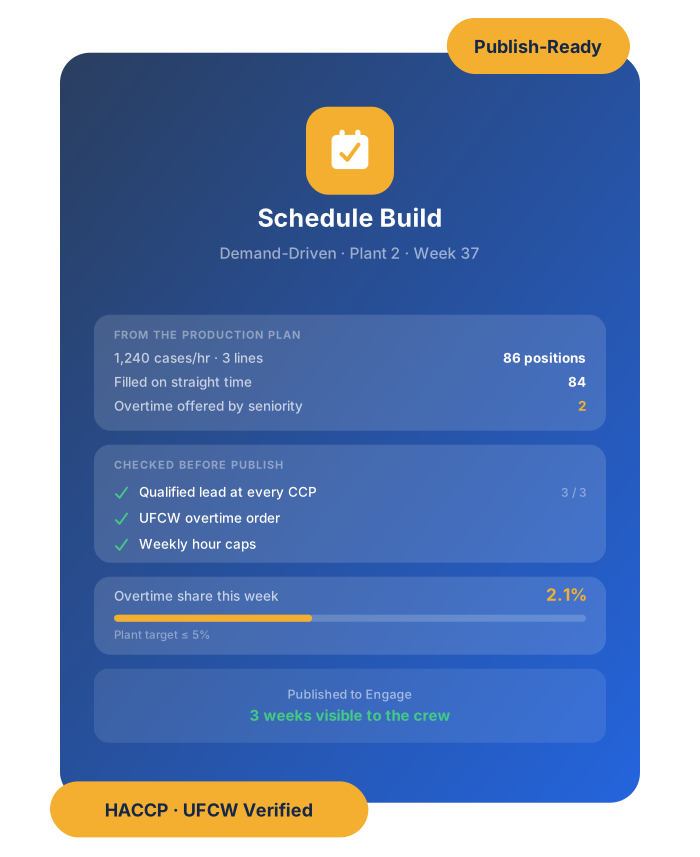
Overtime premium, turnover, and recall exposure are all set at the same moment: when the schedule is built. Indeavor builds the schedule from your production plan, offers overtime by the contract instead of imposing it, and puts the right person in the right place at the right time, every single shift. We schedule what others can't.
"Indeavor Engage has been amazing for our employees and our supervisors. Engage has allowed our supervisors to post real time schedules and jobs for our employees — and for our employees to be able to see their scheduled shifts for the work week."
— Maegan Flora, Treehouse Foods
Trusted by the world's most mission-critical enterprises
Average cost of a food product recall
Average frontline turnover in food processing
Reduction in variable labor spend
Avg annual savings per 500-employee facility
Why do overtime, turnover, and recalls all trace back to scheduling?
Because a single scheduling decision determines how many premium hours the plant pays for, whether workers see their shifts far enough ahead to stay, and who stands at a critical control point. On margins this thin, manual scheduling fails on all three at the same time — and the first two show up on the P&L every month.
One uncertified worker at a CCP is a recall risk
HACCP requires qualified personnel at every critical control point — pasteurization, metal detection, allergen management. When scheduling is manual and certification tracking lives in a spreadsheet, someone gets assigned to a CCP they're not qualified for. The FDA inspector doesn't accept "honest mistake." Recalls average $10M+ and that doesn't count the brand damage.
Seasonal demand spikes break manual scheduling
Harvest season. Holiday production. A major retailer increases their order by 40%. Manual scheduling can't respond fast enough — you end up chronically overstaffed in slow periods and understaffed during peaks, bleeding overtime in both directions. Production targets get missed. Retailers notice.
47% attrition means you're always recruiting and onboarding
Food processing has some of the highest frontline turnover in manufacturing. When workers can't see their schedule until Friday afternoon, can't easily swap shifts, or see OT distributed unfairly — they leave. And every departure triggers a cycle of recruiting, hiring, onboarding, and recertifying that costs you time, money, and institutional knowledge.
Meet George
George is a line operator at a food processing plant. He's 42, married, three kids. His oldest plays middle-school basketball—practice Tuesday and Thursday, games Saturday morning. George isn't looking to get rich. He's looking to do good work, earn a fair wage, and be there for his family. That's the deal he signed up for.

What George Wants
A predictable schedule he can see far enough ahead to plan his life. A way to ask for time off that doesn't require tracking down his supervisor. The option to pick up extra hours when the basketball camp deposit is due. To be treated like a person—not a staffing number on someone's spreadsheet. It isn't a lot to ask. But for most frontline workers in complex 24/7 operations, it isn't how the system works.
Things happen to you.
Next week’s schedule isn’t out. George doesn’t know if he can make Tuesday’s practice or cover Saturday’s game.
Schedule is taped to the break room wall. Tuesday 2 to 10. That kills practice. Supervisor says he’ll look into it. Nothing happens.
Someone called off for the night shift. George’s phone rings. He says no—it’s his practice night. The supervisor is frustrated. George feels guilty.
The supervisor tells him the next shift is short two people. He has to stay until 11. He misses the game.
George opens his phone and starts browsing job boards. Not because he hates the work. Because he hates what the work is doing to his family.
You have a say.
George opens the Engage app. His schedule for the next three weeks is right there. Tuesday’s an early shift—practice is covered. Saturday he’s off—the game is covered.
Tournament schedule drops. George requests the afternoon off through the app. The system checks the rules, verifies coverage, and routes for approval. Approved by lunchtime.
The system finds coverage based on seniority, qualifications, and overtime balance—not by calling George on his practice night.
Basketball camp registration opens. George wants extra hours. The app shows three open shifts on Saturdays. He volunteers. The system verifies he’s qualified. Confirmed in seconds.
George is present. He’s at practice. He’s at games. He’s at dinner. When a buddy from another plant calls to say they’re hiring, George says thanks, but no thanks. He’s not looking anymore.
Multiply George by every frontline worker in the plant. That is how you get to a 47% reduction in attrition. Not through wellness programs. Not through free pizza. By giving George visibility, giving George control, and giving George a life he can plan around.
How does Indeavor cut labor cost without cutting corners?
Demand sets the staffing level, contract rules decide who gets the extra hours, and certifications gate every assignment. If you can write a rule for it, we can automate it. The same engine that takes the overtime out is the one that keeps an unqualified worker off a critical control point: cost control and food safety are one pass, not a trade-off.
How does Indeavor handle seasonal demand swings?
Indeavor ingests your production plan and builds the schedule around forecasted demand. Harvest season, holiday production, ingredient availability, and retailer demand spikes scale staffing up or down without a manual rebuild at every shift change.
- Production schedule drives staffing — ERP-linked
- Seasonal surge workforce management built in
- SKU-level demand matching across lines
- 52% reduction in unbudgeted overtime
How does Indeavor reduce attrition on the plant floor?
For a frontline worker, the schedule is the job experience. Indeavor publishes it weeks ahead in the Engage app, lets people request time off, swap shifts, and volunteer for extra hours from their phone, and offers overtime by the rules instead of imposing it at the end of a shift. Workers who can plan their lives stay — and with Deloitte projecting up to 1.9 million unfilled U.S. manufacturing jobs by 2033, the workers you keep are the ones you never have to find.
- Schedules visible weeks ahead in Engage, not taped to a break room wall
- Time off, swaps, and open shifts requested from a phone, rule-checked and routed for approval
- Overtime offered by seniority and OT balance, never forced at end of shift
- 47% reduction in employee attrition
How does Indeavor automate UFCW and CBA compliance?
Indeavor encodes each clause of your collective bargaining agreement — seniority, overtime distribution, bidding rights, and scheduling fairness — and applies it to every scheduling decision automatically. Grievances that previously consumed weeks of HR and legal time are prevented when the schedule is built.
- UFCW rules applied at every scheduling decision
- 98% reduction in scheduling grievances
- Seniority, bidding, and OT distribution enforced
- Defensible audit trail for every decision
HACCP & FSMA at Every Assignment
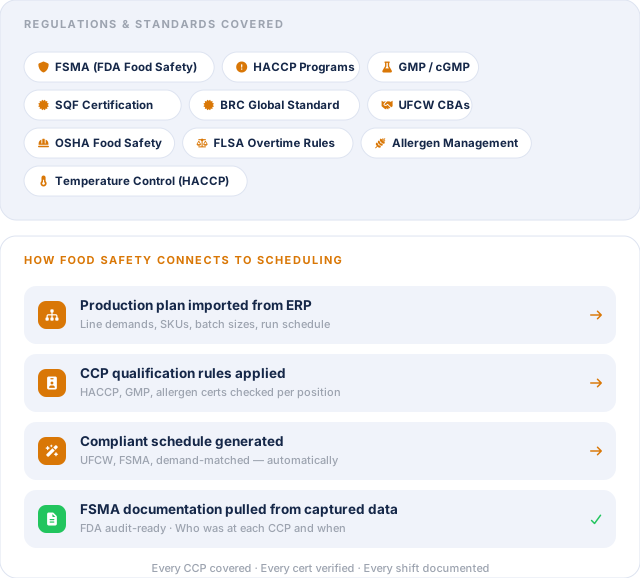
HACCP level, GMP, and allergen qualifications are checked before any critical control point assignment is confirmed, and FSMA records are pulled from captured shift data rather than assembled for the audit.
Automated Assignment Backfill
When a line worker calls off, Backfill finds a GMP/HACCP-qualified replacement automatically — before the shift starts, before the line can backup. The line doesn't wait for a supervisor's phone calls.
Multi-Facility Labor Analytics
OT cost trends, headcount vs. production demand, absenteeism by line and shift — across your entire facility network. Identify recall risk patterns and benchmark performance across plants.
What does cutting overtime
actually look like?
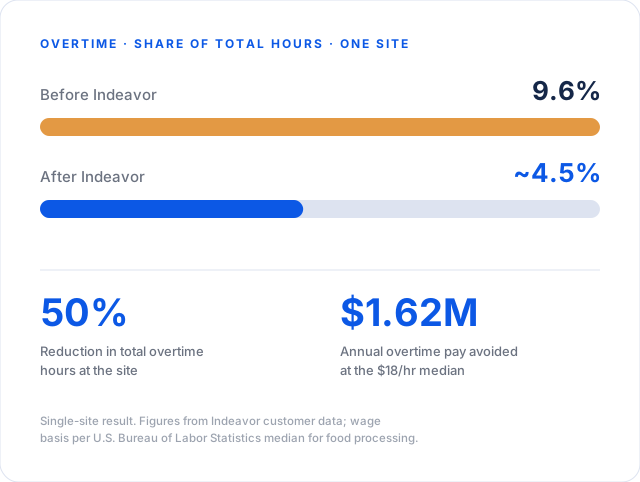
One of the world's largest food and beverage manufacturers implemented Indeavor at one of their global production sites. Total overtime fell roughly 50% — from about 10,000 hours per month to 5,000 — and overtime dropped from 9.6% of total hours worked to around 4.5%.
At the $18 median hourly wage the U.S. Bureau of Labor Statistics reports for food processing work, that is about $135,000 per month in overtime pay avoided — $1.62 million a year — at a single site. Across Indeavor's manufacturing customer base, the overtime rate has declined nearly 30% since early 2023.
What results do food processors see with Indeavor?
Food and beverage customers report a 52% reduction in monthly overtime hours, a 47% reduction in employee attrition, and a 98% reduction in grievances. Results vary by facility, baseline practices, and configuration.
Reduction in monthly overtime hours
Work distributed before overtime becomes necessary
Reduction in frontline attrition
Schedule visibility and fairness drive retention
Fewer scheduling grievances
UFCW and CBA rules applied consistently
What makes Indeavor different from generic scheduling software?
Generic HR tools know employees have certifications. Indeavor knows that a HACCP Level III certification is required at Pasteurization CCP 1, that it expires in 2027, and that if the primary CCP operator calls off on a Thursday at 4 AM, the system needs to find a qualified replacement before the shift — not call the supervisor to manually check a spreadsheet.
-
Every CCP gets its own qualification profile
HACCP levels, allergen certifications, GMP training, SQF operator credentials — defined per critical control point, per facility. Applied to every assignment. No exceptions. -
FSMA documentation pulled from captured data
FDA inspectors want to see who was at each CCP, what their qualifications were, and what the schedule looked like. Indeavor generates this documentation automatically per shift — so you're always audit-ready, never scrambling to reconstruct records. -
Seasonal surge scheduling built in
Harvest windows, holiday production ramps, and retailer demand spikes are predictable. Indeavor helps you plan the seasonal workforce in advance — who needs onboarding, who needs GMP certification, how the schedule restructures — before the surge hits.
What do food and beverage customers say?
"Indeavor Engage has been amazing for our employees and our supervisors. Engage has allowed our supervisors to post real time schedules and jobs for our employees — and for our employees to be able to see their scheduled shifts for the work week. We are looking forward to integrating our systems to continue eliminating our manual processes."
— Maegan Flora, Treehouse Foods
"It used to take us 3 hours to plan forced OT. With our new Forced OT SGM, it only takes us 45 seconds!"
— Stacie Fischer, Operations Leader
"I love the color coding and schedule view. The ease of scheduling employees is a time saver. The employees learned self service quickly and loved viewing their schedule and requesting time off."
— Allison S., Operations Manager
See Indeavor configured for food processing.
Book a 30-minute live demo — we'll show you HACCP qualification enforcement, FSMA documentation, demand-driven scheduling, and UFCW compliance running with real food plant data.
Frequently Asked Questions
Every critical control point in your HACCP plan can be assigned a qualification profile — specifying which certifications (HACCP level, allergen management, GMP training, SQF operator) are required. When a scheduling assignment is created, Indeavor checks the worker’s credentials before confirming it. An unqualified worker cannot be placed at a CCP. FSMA documentation showing who was at each CCP, their qualifications, and their assignment history is pulled from captured shift data.
Indeavor integrates with your ERP to ingest production plans, SKU demands, and run schedules — and builds staffing around actual production needs rather than fixed shift groups. During harvest windows or holiday production ramps, the system scales staffing up automatically, matching qualified workers to each line’s requirements. During slow periods, it scales down without overstaffing. Seasonal surge workforce planning (onboarding timing, certification scheduling, headcount projections) can be managed in advance.
Indeavor encodes every clause of your UFCW collective bargaining agreement — seniority rules, overtime distribution, bidding rights, bumping procedures, rest period requirements — into the scheduling engine. These rules are enforced automatically on every scheduling decision. When a grievance is filed, the complete audit trail (who was scheduled, in what order, which rule determined the outcome, and the timestamp) is available immediately for defense.
Indeavor provides real-time dashboards showing labor performance against production targets — by line, shift, SKU, and facility. Analytics include overtime cost trends, headcount vs. production demand, absenteeism rates by department, OT distribution equity, and qualification gap analysis (which positions are hardest to staff due to certification shortfalls). Multi-facility benchmarking lets you identify best practices and reallocate skilled labor across your network.
Yes. Indeavor integrates with SAP, Oracle, Workday, ADP, and other ERP and HRIS systems through an API-first architecture. Production demand flows from ERP into Indeavor. Finalized schedules, time records, and compliance documentation flow back to T&A, payroll, and your food safety management systems. No manual data entry. No reconciliation. One source of truth across scheduling, production, and HR data.
Workforce management software for food processing schedules production labor while enforcing food safety and labor rules at the same time. It tracks HACCP, GMP, allergen, and SQF certifications, matches staffing levels to the production plan, and applies union contract terms to each assignment — so the schedule itself becomes a food safety control rather than a separate administrative task.
Yes. Seasonal and temporary workers are managed in the same system as permanent staff, each with their own certification profile and contract terms. Surge staffing for harvest windows, holiday production, and retailer demand spikes is scheduled against the same qualification and CBA rules as the core workforce, so a temporary worker cannot be placed at a CCP they are not certified for.
Implementation timelines depend on the number of facilities, the complexity of your collective bargaining agreements, and which ERP, HRIS, and food safety systems are being integrated. Most food processing customers run a phased rollout, starting with a single plant to validate the configuration before extending it across the network.
Keep every CCP covered.
Keep every product safe. Automatically.
HACCP certifications verified. FSMA documentation generated.
UFCW rules enforced. Seasonal demand matched.
Every shift, every line, without a single manual check.