











OIL & GAS · AUTOMATED 24/7 FRONTLINE SHIFT SCHEDULING
In oil and gas, a fatigued operator at 3 AM is the risk before the report.
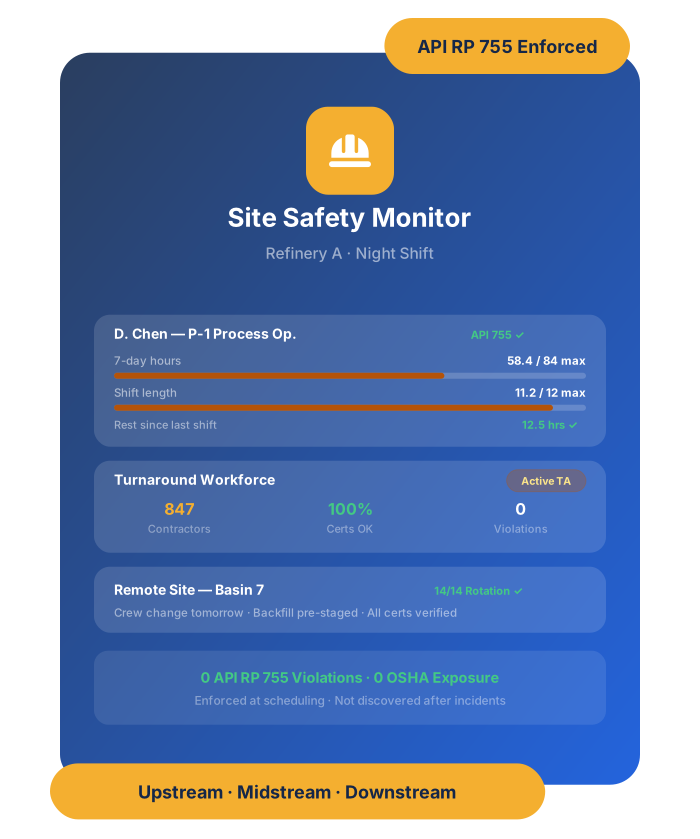
Indeavor automates fatigue management to API RP 755 standards across upstream, midstream, and downstream operations — managing 14/14 rotations, turnaround workforces, remote site scheduling, and emergency mobilization from a single platform.
"Since 2012, upwards of 1,100 investigations into oil, gas, and chemical industry employers have recovered more than $40 million for more than 29,000 workers nationally."
— U.S. Department of Labor, Wage and Hours Division
Trusted by the world's most mission-critical enterprises
Weekly hours threshold above which injury risk rises sharply
DOL labor violations recovered from O&G employers since 2012
Reduction in overtime hours
Avg annual savings per 500-person operation
Why does manual scheduling fail across fatigue, turnarounds, and remote sites?
Because each one breaks a different assumption. Fatigue rules require counting hours across rolling windows, turnarounds triple headcount for a fixed window, and remote rotations put workers on site for weeks at a time. A spreadsheet handles none of the three reliably at the same time.
A fatigued process operator at 3 AM is the risk that precedes the incident report
API RP 755 exists because the industry learned from events where fatigued workers contributed to serious incidents. Research documents injury risk rising sharply above 60 hours per week and after extended consecutive shift sequences. Manual scheduling cannot track cumulative fatigue hours accurately across rotating workforces, contractors, and multiple sites — leaving exposure that only surfaces after an incident or an OSHA investigation.
Turnaround management breaks manual scheduling every time
A major refinery turnaround brings 2,000–5,000 contractors to a single site. Each one must be tracked for API RP 755 compliance from day one of covered work — certifications, hours, rest periods, the lot. Manual tracking of that workforce is operationally impossible without a system built for it. The result is either chronic compliance exposure or a dedicated team doing nothing but administrative fatigue tracking.
An uncertified operator on heavy equipment is the OSHA incident your safety team can't explain
A field crew on a 14/14 rotation in a remote basin or offshore platform isn't reachable by a centralized HR team using spreadsheets. Certification lapses, scheduling gaps, and backfill failures become invisible until the crew change flight lands — and by then the problem is already on location. Real-time visibility into remote workforce status prevents discoveries from turning into incidents.
Meet Tomás
Tomás is a control room operator at a refinery. He's 45, seventeen years in, and works a rotation that puts him on nights every third week. His daughter graduates high school in May. He has not missed a milestone yet and does not intend to start.

What Tomás wants
The rotation published far enough ahead to book a flight for his mother. Turnaround dates he can plan a life around. Fatigue limits that hold when the plant is short. And a fair shot at turnaround overtime, which is how he's paying for the first year of tuition. It isn't a lot to ask. But for most frontline workers in complex 24/7 operations, it isn't how the system works.
Things happen to you.
Turnaround dates shift. Tomás hears about it at the toolbox talk. He had already booked his mother’s flight for the wrong week.
Two operators leave. Tomás picks up an eighth consecutive twelve, one past what the fatigue guidance allows. Nobody flags it because nobody is counting.
He asks for graduation weekend off. His supervisor writes it on a whiteboard. The whiteboard gets erased.
He’s on the schedule and he works it. He watches the ceremony on his wife’s phone that night.
A recruiter calls about a plant an hour away with a fixed rotation. For the first time in seventeen years, Tomás asks what it pays.
You have a say.
The full-year rotation and the turnaround window are in the app. Tomás books his mother’s flight once, correctly.
Consecutive-day and rest rules are applied when the schedule is built. An eighth twelve doesn’t get assigned, because the rule won’t allow it.
He requests graduation weekend in the app. The system checks coverage and contract rules and routes it. Approved, and in the record instead of on a whiteboard.
Overtime opportunities post to the app. Tomás volunteers for the shifts that pay best and still clear his rest requirements. Tuition gets covered.
He’s in the third row.
How does Indeavor handle API RP 755, rotations, turnarounds, and remote sites?
Indeavor holds fatigue limits, rotation patterns, and site rules as constraints applied when the schedule is generated. Consecutive-day limits and rest requirements are enforced during turnarounds, when the pressure to exceed them is highest.
How does Indeavor automate API RP 755 fatigue management?
Indeavor applies API RP 755 limits — maximum consecutive days, shift length, and minimum rest between shifts — when the schedule is built. An assignment that would breach a limit is not made, so the rule holds during turnarounds and short-staffed periods rather than bending under them.
- API RP 755 hour and rest limits enforced at scheduling
- Real-time cumulative hour tracking per worker
- Contractors tracked from day one of covered work
- OSHA General Duty Clause exposure eliminated
How does Indeavor manage turnaround and outage staffing?
Turnarounds are planned as their own staffing event, scaling headcount for a defined window and then scaling back down. Contract and supplemental workers are scheduled in the same system as permanent staff, under the same fatigue and qualification rules.
- Contractor workforce management at scale (2,000–5,000+)
- Certification verification for all trades on site
- Turnaround schedule optimization and critical path support
- API RP 755 compliance tracked through full event
How does Indeavor schedule remote site and offshore rotations?
Rotational patterns such as 14/14 and 21/21 are configured as rules, with travel days, crew changes, and rest requirements built in. Rotations can be published months ahead, which is what makes them plannable for workers who are away from home for weeks at a time.
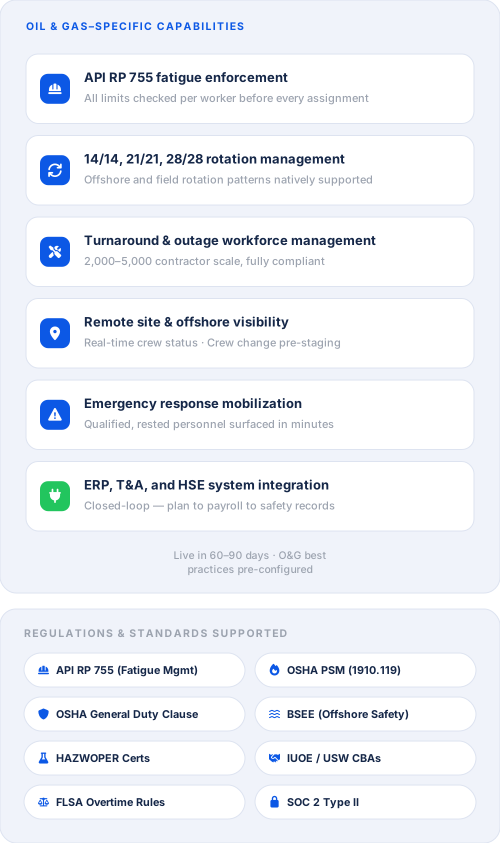
- 14/14, 21/21, 28/28 rotation patterns natively supported
- Crew change management with backfill pre-staging
- Real-time visibility into remote workforce status
- Certification tracking for field and offshore personnel
Emergency Response Mobilization
When an emergency shutdown, spill response, or equipment failure requires immediate workforce mobilization, Indeavor surfaces qualified, rested personnel and deploys the right team in minutes — not hours.
Skills & Certification Enforcement
Process safety, H2S awareness, confined space entry, HAZWOPER, fall protection, hot work permits — qualification profiles enforced at every assignment for every critical role.
Field Worker Self-Service (Engage)
Field operators and technicians see their rotation schedule, request time off, and call off — from the Engage app, wherever they are. No phone calls, no hold music, no information gaps between sites.
What results do oil and gas operations see?
Energy and industrial customers report fatigue limits held through turnaround windows, reduced unplanned overtime, and rotations published far enough ahead for workers to plan around. Results vary by site, rotation pattern, and baseline practices.
API RP 755 compliance
Rules enforced at scheduling — not after incidents
Reduction in frontline attrition
Fair rotations and schedule visibility retain field workers
Per week back to supervisors
Scheduling admin eliminated — field leadership restored
How does Indeavor work across the rig,
the refinery, and
the remote basin?
Oil and gas workforce management isn’t just industrial scheduling with fatigue rules added. It’s managing crews in locations with no reliable connectivity, tracking contractor workforces that outnumber permanent staff during turnarounds, mobilizing emergency response teams in minutes, and maintaining API RP 755 compliance across all of it simultaneously. Indeavor was built for that operational reality.
-
API RP 755 + OSHA PSM compliance managed together
API RP 755 fatigue management and OSHA Process Safety Management compliance requirements overlap at every scheduling decision in downstream operations. Indeavor enforces both simultaneously — not as separate systems requiring separate checks. -
Contractor workforce at turnaround scale
During turnarounds, contractor workers outnumber permanent staff by ratios of 5:1 or more. Indeavor manages the full contractor population — certification validation, fatigue hour tracking from day one, and demobilization — with the same compliance rigor as permanent employees. -
Emergency response in minutes, not hours
When an emergency shutdown, equipment failure, or spill response requires immediate workforce mobilization, Indeavor surfaces qualified, rested, available personnel across every site and dispatches the right team — quickly enough to matter in a safety event.
Which oil and gas sectors does Indeavor support?
Upstream E&P
Drilling rig crews, completion teams, production operations — 14/14 and 28/28 rotations, remote basin scheduling, wellsite crew changes, emergency response mobilization.
Midstream Pipelines
Pipeline patrol teams, compressor station operators, control room scheduling, right-of-way maintenance — geographically distributed workforce across long-haul infrastructure.
Downstream Refining
24/7 shift operations, OSHA PSM compliance, major turnarounds, CBA management for union refinery workers, process operator qualification tracking.
LNG & Petrochemical
LNG terminal operations, liquefaction plant staffing, 24/7 production runs, rigorous safety certification requirements, large-scale outage scheduling.
What do oil, gas, and chemical customers say?
"It used to take us 3 hours to plan forced OT. With our new Forced OT SGM, it only takes us 45 seconds!"
— Stacie Fischer, Operations Leader
"The platform saves time by automating fatigue rule calculations and reduces the risk of errors — saving money by eliminating excess labor costs and the risk of compliance violations."
— Energy Operations Leader
"Indeavor has become a one-stop shop by streamlining internal workflows and combining different processes and applications, resulting in a lot of time saved across multiple work groups."
— John Truong, Xcel Energy
See Indeavor configured for oil & gas.
Book a 30-minute live demo — API RP 755 fatigue enforcement, turnaround workforce management, 14/14 rotation scheduling, and remote site visibility configured for your operations.
Frequently Asked Questions
Indeavor enforces API RP 755 fatigue limits at the point of scheduling — before any assignment is confirmed. The system tracks each worker’s cumulative hours within the applicable time windows, minimum rest period since their last shift, and work schedule constraints in real time. If a proposed assignment would create a fatigue compliance violation, it is blocked before confirmation. This prevents violations from occurring rather than documenting them after the fact, when the safety exposure has already happened and OSHA exposure under the General Duty Clause has already been created.
Yes. Indeavor allows real-time schedule adjustments for unexpected events — emergency shutdowns, equipment failures, spill responses, weather-driven crew changes, or sudden maintenance requirements. When mobilization is needed, Indeavor surfaces qualified, rested, available personnel who meet the specific certification requirements for the emergency role. API RP 755 fatigue compliance is checked even for emergency assignments — because a fatigued emergency response team creates additional risk rather than reducing it.
Turnarounds bring contractor workforces that can number in the thousands to a single site, each subject to API RP 755 fatigue requirements from the first day of covered work. Indeavor manages the full turnaround workforce lifecycle: credential verification, fatigue hour tracking from day one, schedule optimization for critical path activities, and compliance monitoring through demobilization. The same fatigue compliance rigor applied to permanent employees applies to every contractor on the turnaround.
Yes. Indeavor natively supports the rotation patterns common in O&G field and offshore operations — 14/14, 21/21, 28/28, and custom patterns. Crew changes are managed proactively: the system identifies the incoming crew’s certification status and fatigue compliance well before the rotation date, stages backfill automatically if a gap is identified, and provides supervisors with complete visibility into remote workforce status without requiring manual site check-ins.
Field operators and technicians can access their rotation schedule, request time off, swap shifts within compliance rules, and submit call-offs from the Indeavor Engage mobile app — wherever they are, including remote locations with limited connectivity. Schedule visibility and self-service tools directly address the schedule unpredictability and lack of agency that drive turnover in O&G field operations, contributing to the 47% attrition reduction seen across Indeavor customers.
API RP 755 is the recommended practice for fatigue risk management in refining and petrochemical operations, covering shift length, consecutive days worked, and minimum rest. Scheduling software helps by applying those limits as constraints when the schedule is generated, so a non-compliant assignment cannot be created during the turnaround periods when the risk is highest.
Rotational patterns are configured once as scheduling rules, including travel days, crew change timing, and the rest requirements that follow a hitch. Because the pattern is in the system, the full-year rotation can be published in advance rather than assembled a month at a time.
Yes. Contract and supplemental workers are scheduled in the same platform as permanent staff, each with their own qualifications and applicable rules. This matters most during turnarounds, when the contract population is largest and fatigue tracking is most likely to fragment across systems.
Every worker rested and qualified.
Every site visible. Every assignment compliant.
API RP 755 enforced. 14/14 rotations managed. Turnarounds under control.
Remote sites visible. The operational and safety outcomes O&G leadership requires.