











TRANSPORTATION · AUTOMATED 24/7 FRONTLINE SHIFT SCHEDULING
Ensure Delivery Timelines, Improve Operational Efficiency, and Reduce Scheduling Errors.
Automated workforce management built for complex logistics networks. Align labor with delivery schedules, route demands, and facility needs across drivers, warehouse workers, and dispatch teams.
Trusted by the world's most mission-critical enterprises
Max FMCSA civil penalty per HOS offense
Of logistics organizations are facing acute talent shortages
OT reduction through demand-matched staffing
HOS compliance enforced at dispatch
Why do scheduling errors cost so much in transportation and logistics?
Because a dispatch decision made under pressure is hard to unmake. One driver sent out past an Hours of Service limit, one union rule applied inconsistently, or one coverage gap discovered too late, and the cost shows up as a civil penalty, a grievance, or a missed delivery.
One HOS violation carries a $16,000 penalty
Dispatching a driver past the 11-hour driving limit, the 14-hour duty window, or the 60/70-hour cycle isn't just a safety risk — it's a maximum FMCSA civil penalty of $16,000 per offense, discovered at inspection or after an incident rather than before dispatch.
A manual run-bid becomes a grievance
Union seniority order, run-bidding, and callback procedures are precise by design. Applied by hand under dispatch pressure, one inconsistency is enough to trigger a grievance — and inconsistency across dispatchers, not intent, is usually the cause.
A coverage gap becomes a missed delivery
When a driver calls off or a route changes, the gap has to be found, and a qualified, HOS-legal replacement has to be identified, before the delivery window closes — not after a customer calls asking where their shipment is.
Meet Renée
Renée has driven a city transit route for fifteen years. She's 47, holds a CDL with a passenger endorsement, and has her son every other weekend. That custody schedule is a court document. It does not flex when the run board changes.

What Renée Wants
Run bidding that follows seniority every time, in writing. A schedule that respects her custody weekends. Hours of Service limits checked before she's dispatched rather than after. And extra work when she wants it, posted at the depot instead of arriving as a phone call at 5:00 AM. It isn't a lot to ask. But for most frontline workers in complex 24/7 operations, it isn't how the system works.
Things happen to you.
Run bidding happens on paper in a back office. Renée isn’t certain the seniority order was followed and has no way to check.
She’s assigned a run on a Saturday she has her son. She trades with a coworker in the break room and hopes dispatch writes it down.
Dispatch calls to cover an open run. She drove nine hours the day before. Nobody checks her hours until she raises it herself.
The trade was never recorded. She’s marked as a no-show for a run she traded away.
The no-show is in her file. She files a grievance and starts asking around about the school district’s bus routes.
You have a say.
Run bidding runs in the system by seniority. Renée sees her position, the runs available to her, and the order they were awarded.
There’s already a ranked list of people eligible and willing. They get asked. Nobody gets told. Marcus isn’t on that list on a class night, because the rule lives in the system instead of someone’s memory.
An open run needs coverage. The supervisor runs backfill, and the system rules out anyone who would exceed Hours of Service limits before the call list exists. Renée’s phone doesn’t ring.
She requests a trade in the app. The system checks qualifications and hours, routes it, and records it. No break-room handshakes.
Open runs post to the app. She picks up the ones that fit around her weekends.
How does Indeavor build transportation schedules automatically?
Indeavor aligns labor with delivery schedules, route demands, and facility needs in a single automated pass. Driver hours, qualifications, union terms, and site coverage are applied together, so the schedule that publishes is already compliant rather than corrected afterward.
How does Indeavor build schedules around delivery demand?
Indeavor aligns labor with delivery schedules, route demands, and facility needs, eliminating manual scheduling and last-minute dispatch chaos across every route and location.
- Consistent coverage for drivers, warehouse workers, and dispatch teams
- Demand balanced against availability across all logistics hubs
- TMS/WMS/HRIS integration for centralized labor strategy
- 99% of schedule creation automated
How does Indeavor enforce FMCSA Hours of Service?
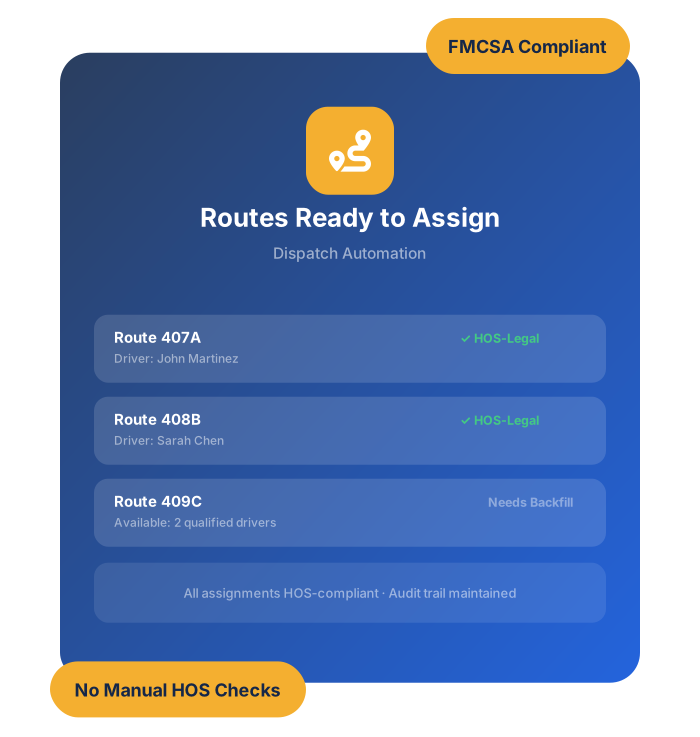
Every dispatch assignment is checked against FMCSA Hours of Service limits before it is confirmed. Assignments that would exceed a limit are flagged for review, and the assignment history is retained for DOT audit purposes.
- 11-hour driving limit & 14-hour duty window checked
- 30-minute break & 60/70-hour cycle limits enforced
- CDL classes and endorsements verified before assignment
- Full audit trail retained for DOT inspections
How does Indeavor manage union run bidding and seniority?
Run bidding, seniority order, overtime distribution, and callback procedures are configured as rules and applied automatically — no manual interpretation, no inconsistency across dispatchers.
- Seniority order and run-bidding enforced automatically
- Fair, transparent overtime distribution tracked by the system
- Operators see their position and available runs directly
- Every award carries a record of the order it was made in
Absence & Backfill Management
A call-off or route change surfaces the coverage gap immediately. Backfill ranks candidates by seniority and OT balance, not who answers the phone first.
Employee Self-Service (Engage)
Drivers manage availability, shift swaps, and time-off requests, and volunteer for extra runs, from the Engage app.
Multi-Depot Labor Analytics
Overtime trends, absenteeism, and coverage performance are captured across depots and pulled from captured scheduling data, not reconstructed after the fact.
What results do transportation operators see?
Transportation and logistics customers report reduced unplanned overtime, HOS compliance enforced before dispatch rather than discovered after, and schedule creation returned to automation. Results vary by fleet size, contract structure, and baseline dispatch practices.
Automation of schedule creation
Even across multi-depot, multi-region networks
Reduction in variable labor spend
Align staffing with real-time demand
Reduction of temp labor
Forecast demand to set adequate staffing levels
What transportation scheduling complexity does Indeavor handle?
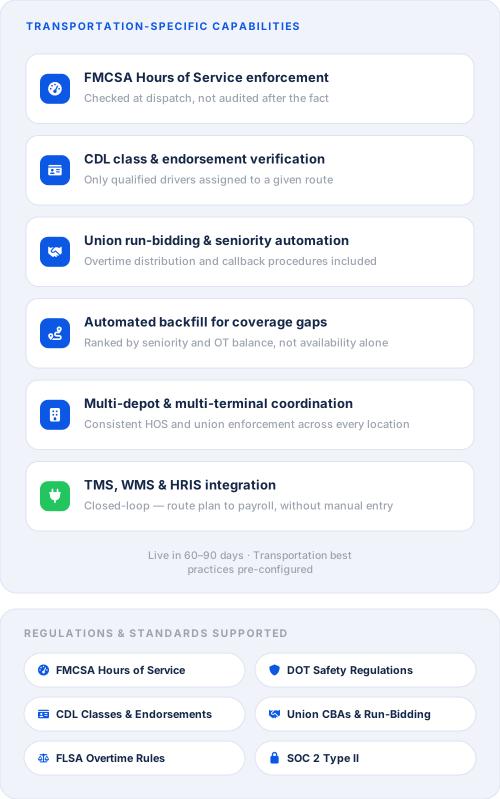
Generic HR tools approximate transportation scheduling. Indeavor was engineered for it — knowing the difference between the 11-hour driving limit and the 14-hour duty window, understanding how run-bidding and seniority interact, and recognizing that a dispatch decision has to be HOS-legal before it can be confirmed, not corrected afterward.
-
Hours of Service, checked before dispatch
The 11-hour driving limit, 14-hour duty window, 30-minute break requirement, and 60/70-hour cycle limits are checked against every assignment before it confirms — not audited after the fact. -
CDL classes and endorsements verified
Only drivers holding the required CDL class and endorsement for a given route or vehicle are eligible for the assignment. -
Run-bidding and seniority, applied consistently
Seniority order, run-bidding, overtime distribution, and callback procedures are configured as rules, so every dispatcher applies them the same way, every time. -
Multi-depot visibility, one audit trail
Depots, terminals, and regions are managed from one platform, with a complete record of every labor decision retained for DOT audits and grievance defense.
Which transportation and logistics teams does Indeavor support?
Drivers & Dispatch
HOS-legal assignments, CDL verification, and run-bidding applied at the moment of dispatch.
Warehousing & Distribution
Warehouse staffing aligned with delivery volume and throughput across every facility.
Depots & Terminals
Multiple depots and terminals managed from one platform with consistent rule enforcement.
Route & Delivery Operations
Staffing planned against route demand, seasonality, and service-level commitments.
What do transportation & logistics customers say?
"It used to take us 3 hours to plan forced OT. With our new Forced OT SGM, it only takes us 45 seconds!"
— Stacie Fischer, Operations Leader
"I love the color coding and schedule view. The ease of scheduling employees is a time saver. The employees learned self service quickly and loved viewing their schedule and requesting time off."
— Allison S., Operations Leader
See Indeavor configured for transportation & logistics.
Book a 30-minute live demo — we'll show you FMCSA HOS enforcement, union run-bidding, and automated backfill running with real transportation scheduling scenarios.
Frequently Asked Questions
Automated scheduling significantly reduces the time spent creating employee schedules and prevents under- or over-allocation of labor. This enables transportation and logistics organizations to respond quickly to route changes, maximize workforce utilization, and ultimately enhance profitability by eliminating unnecessary labor costs.
Indeavor helps the transportation industry stay compliant by automatically enforcing DOT Hours of Service rules, union agreements, and certification requirements. The platform ensures only qualified, rested employees are scheduled, while maintaining a full audit trail of every labor decision for transparency and regulatory readiness.
Yes, Indeavor’s workforce management solutions can integrate with your TMS, WMS, HRIS, and other existing systems for seamless end-to-end workforce management across your entire operation.
Workforce management software for transportation schedules drivers and frontline staff while enforcing the regulations and agreements that govern them. It checks FMCSA Hours of Service limits before dispatch, verifies CDL classes and endorsements, applies union seniority and run-bidding rules, and aligns staffing with route and delivery demand.
Every dispatch assignment is checked against FMCSA Hours of Service limits before it is confirmed, including the 11-hour driving limit, 14-hour duty window, 30-minute break requirement, and 60/70-hour cycle limits. Assignments that would exceed a limit are flagged for review, and the assignment history is retained for DOT audit purposes.
Yes. Run bidding, seniority order, overtime distribution, and callback procedures are configured as rules and applied automatically. Operators can see their position and the runs available to them, and each award carries a record of the order it was made in.
Yes. Drivers, routes, and crews across multiple depots, terminals, and regions are managed from one platform. Hours of Service enforcement and union compliance apply consistently across locations, while labor analytics roll up across the network for comparison.
If the DOT can audit it,
we’ve already checked it.
Route demand aligned. HOS enforced. CDLs verified. Seniority followed.
Dispatchers back on the board where they belong.