










MANUFACTURING · AUTOMATED 24/7 FRONTLINE SHIFT SCHEDULING
Manufacturing Scheduling that Adapts to Production Demand. Not the Other Way Around.
Indeavor automates workforce planning across multi-line operations — matching labor to demand in real time, enforcing CBA and OSHA rules automatically, and giving every supervisor 10–15 hours back each week to actually run the floor.
"Indeavor Solutions provided me the best employee scheduling tool. It helped a lot while scheduling the various activities of employees. The best ever workforce management tool — it is very easy to handle and provides reliable management."
— Manufacturing Operations Leader
Trusted by the world's most mission-critical enterprises
Of OT costs are unbudgeted in manual operations
Avg penalty per person for OT miscalculations
Reduction in overtime hours
Reduction in variable labor spend
How does scheduling drive overtime, safety incidents, and production gaps?
Every unplanned overtime event, every safety incident from an uncertified assignment, and every production gap from a slow-to-respond schedule share one root cause: a schedule built by hand that cannot keep pace with what the floor actually needs.
The production plan changes Monday. The schedule shouldn't still be wrong Thursday.
When a rush order arrives, a line changeover is moved up, or a customer pushes a shipment earlier — manual scheduling cannot respond fast enough. Supervisors spend hours rebuilding a schedule that was already done. By Thursday they're still chasing Monday's demand signal. Every day of lag is unoptimized labor: either understaffed against demand or carrying idle overtime.
~60% of overtime costs are unbudgeted — that's not bad luck, it's bad scheduling
Unbudgeted overtime is a symptom of reactive staffing: understaffed when demand peaks, overstaffed when it drops. Without automated demand-matching, supervisors default to overtime as the gap-fill — at a 50% premium over straight time. Across a 500-person facility, that unplanned premium compounds quickly into a line item that appears on the P&L every single month.
An uncertified operator on heavy equipment is the OSHA incident your safety team can't explain
Forklift certification, crane operation, lockout/tagout, welding qualifications — manufacturing floors run on safety-critical credentials. When a supervisor manually assigns someone to a job without checking certification status, one incident later the OSHA citation is specific: failure to ensure qualified operation. Manual credential tracking misses the lapse every time.
Meet Marcus
Marcus runs a CNC cell on second shift. He's 38, eleven years on the floor, and two semesters from an associate's degree in industrial maintenance. Classes are Monday and Wednesday nights. He isn't trying to leave. He's trying to move up, at the same company, on the same floor. That's the deal he's trying to make work.

What Marcus Wants
A base schedule stable enough to commit to a class. Overtime that gets offered before it gets assigned. Credit for the certifications he's earned. To finish the degree without choosing between the classroom and the paycheck. It isn't a lot to ask. But for most frontline workers in complex 24/7 operations, it isn't how the system works.
Things happen to you.
The Monday-Wednesday section is the only one offered. Marcus has no idea whether his schedule will let him attend it. He registers anyway, because waiting another year is worse.
Overtime is mandatory. His supervisor tells him he’s staying. Marcus misses the first class of the semester. The instructor doesn’t take attendance. The material doesn’t wait.
Same again. There’s no list of who’s willing, so the supervisor walks the aisle and picks whoever is standing there.
Marcus asks whether Mondays and Wednesdays could stay clear. His supervisor says he’ll try. There’s nowhere to record it, so it holds or it doesn’t depending on who’s running the floor that night.
Marcus withdraws. Two semesters becomes four. He starts wondering whether the maintenance opening across town comes with a schedule he can plan around.
You have a say.
Marcus’s base schedule is in the Engage app and his class nights are clear in it. He registers knowing what he’s committing to, and the schedule holds, because class nights are part of the pattern it’s built from rather than an exception someone has to remember to honor.
There’s already a ranked list of people eligible and willing. They get asked. Nobody gets told. Marcus isn’t on that list on a class night, because the rule lives in the system instead of someone’s memory.
Saturday shifts post to the app. He volunteers, the system verifies his certifications, and it’s confirmed.
He finishes his maintenance certification. It’s recorded in the skills matrix, and he starts showing up as qualified for assignments that pay more.
Marcus applies for the maintenance opening at his own plant. He gets it. Eleven years becomes twenty.
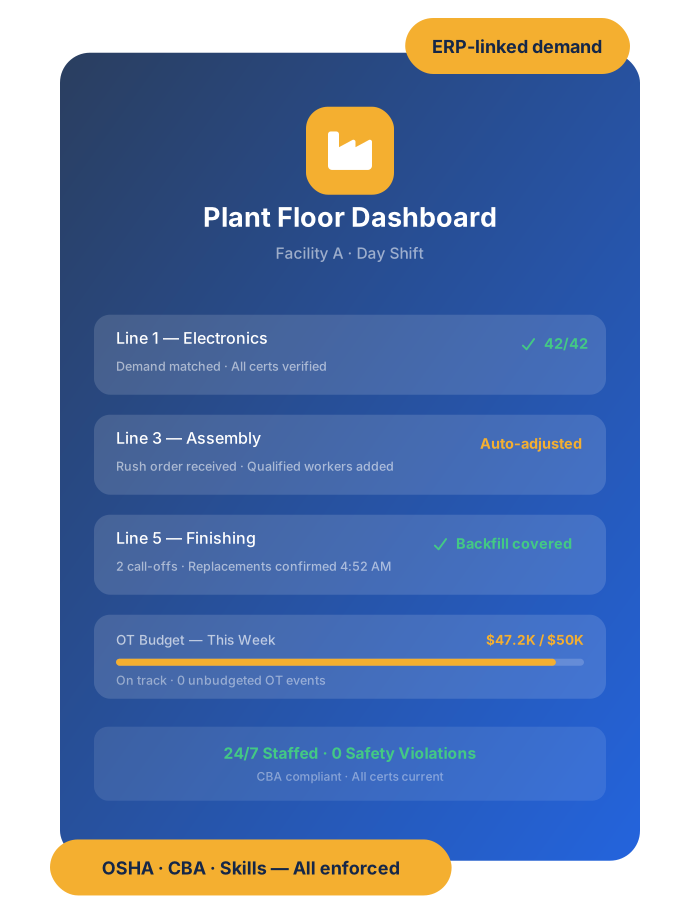
Multiply Marcus by every operator who is one obstacle away from leaving. That is how a 52% reduction in overtime hours happens without anyone losing the ability to earn. Overtime stops being something handed to people and becomes something people choose.
How does Indeavor put the right person on the right line?
Indeavor generates schedules from production demand, matches each assignment against the operator's certifications, and applies CBA rules before the schedule is published. Demand-driven, skill-matched, and compliance-enforced in a single pass rather than three separate manual reviews.
How does Indeavor build schedules from production demand?
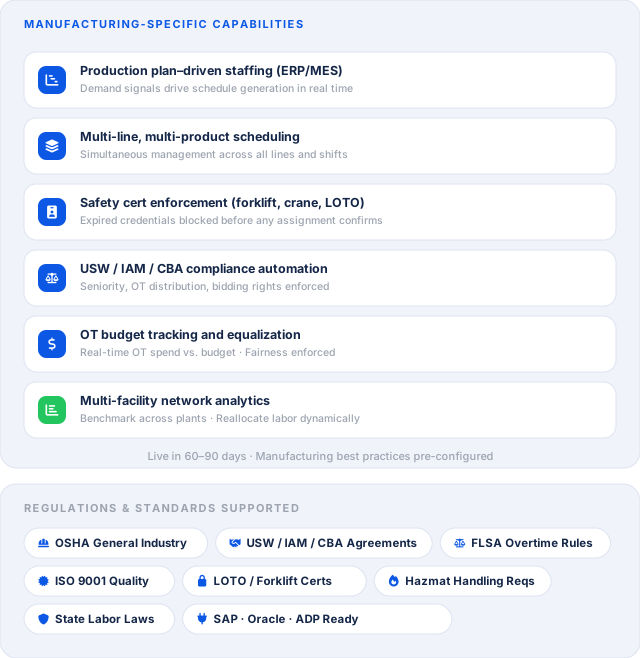
Indeavor ingests production plans and ERP data, then generates optimized staffing automatically rather than reusing last week's template. When demand changes, the schedule adapts: line additions, changeovers, rush orders, and demand pull-forwards are handled without a manual rebuild.
- Production plan drives staffing — ERP and MES-linked
- Real-time demand response across all lines
- 99% schedule automation — manual work eliminated
- Multi-line, multi-product scheduling from one system
How does Indeavor automate CBA and labor law compliance?
Every CBA clause is configured once and enforced on every scheduling decision — seniority, overtime distribution, shift bid rights, and callback procedures. FLSA overtime rules, break period requirements, and state labor law are applied automatically, and grievances drop when rules are applied consistently every shift.
- Union CBA rules applied at every assignment
- FLSA overtime, breaks, and fair distribution enforced
- 98% reduction in scheduling grievances
- Audit trail per scheduling decision — arbitration-ready
How does Indeavor prevent unqualified assignments?
Indeavor checks certifications before confirming every assignment, and an expired credential blocks the assignment automatically with no supervisor override. Each position carries a qualification profile covering forklift, crane, lockout/tagout, CNC operation, welding, and hazmat handling requirements.
- Safety certifications verified at every assignment
- Expiry tracking with 60-day advance alerts
- OSHA qualification requirements enforced
- Best-qualified candidate ranked for backfill
Automated Assignment Backfill
When a line worker calls off, qualified backfill is found and outreach starts automatically — before the shift starts. The line doesn't wait for a supervisor's phone calls.
Employee Self-Service (Engage)
Line workers see their schedule, swap shifts, request time off, and volunteer for open shifts — from the Engage app, all within CBA and qualification rules.
Multi-Facility Labor Analytics
OT cost trends, headcount vs. demand, absenteeism by line and shift — across your entire plant network. Benchmark performance and share labor across facilities.
What results do manufacturers see with Indeavor?
Manufacturing customers report a 99% schedule automation rate, 47% lower frontline attrition, and 10–15 hours returned per supervisor each week. Results vary by facility, product mix, and baseline scheduling practices.
Schedule automation rate
Across multi-line, multi-shift operations
Reduction in frontline attrition
Schedule fairness and visibility drive retention
Returned per supervisor / week
Back on the floor, not building spreadsheets
How much time does automated scheduling save manufacturing supervisors?
Manufacturing supervisors spend 10–15 hours a week building and reworking schedules by hand — time meant for hitting production targets, managing quality, and developing the team. Automating schedule generation returns those hours to the floor.
-
ERP integration closes the loop from plan to floor to payroll
Production demand flows in from your ERP. Optimized schedules flow out to T&A and payroll. Skills data flows back to HR. No manual reconciliation, no system-switching, no data gaps between what was planned and what was actually worked. -
Multi-product, multi-line scheduling handled simultaneously
A facility running five product lines with different equipment requirements, certification levels, and shift patterns isn't a scheduling challenge for Indeavor — it's the normal case. The platform handles all five simultaneously, with different rules applied per line and per position. -
Network analytics let you reallocate labor across facilities
When one facility is overstaffed and another is running on overtime, Indeavor shows you both — in real time. Labor analytics across your facility network surface reallocation opportunities before the OT costs accumulate.
Which manufacturing environments does Indeavor support?
Electronics & Consumer Goods
High SKU variability, rapid demand changes, multi-line switching, ESD and cleanroom certification tracking.
Metals & Fabrication
Welding certifications (AWS D1.1+), crane and forklift credentials, hot work permits, multi-shift heavy manufacturing.
Hazmat handling certifications, PSM process safety, fatigue management for 12-hour shift operations, OSHA PSM compliance.
Packaging & Converting
High-speed line changeover scheduling, seasonal volume spikes, multi-SKU demand alignment, GMP requirements for food-adjacent packaging.
Industrial Equipment
Custom order scheduling, skilled machinist and CNC operator credential tracking, low-volume high-mix production planning.
Textiles & Apparel
Seasonal fashion cycle scheduling, operator skill level tracking across specialized machinery, compliance with labor standards for global supply chains.
What do manufacturing customers say?
"It used to take us 3 hours to plan forced OT. With our new Forced OT SGM, it only takes us 45 seconds!"
— Stacie Fischer, Operations Leader
"I love the color coding and schedule view. The ease of scheduling employees is a time saver. The employees learned self service quickly and loved viewing their schedule and requesting time off."
— Allison S., Operations Leader
"Indeavor Engage has been amazing for our employees and our supervisors. Engage has allowed our supervisors to post real time schedules and jobs for our employees — and for our employees to be able to see their scheduled shifts for the work week. We are looking forward to integrating our systems to continue eliminating our manual processes."
— Maegan Flora, Treehouse Foods
See Indeavor configured for manufacturing.
Book a 30-minute live demo — demand-driven scheduling, CBA compliance, skills enforcement, OT tracking, and backfill automation working with real manufacturing data.
Frequently Asked Questions
Automated scheduling eliminates the manual work of building and rebuilding shift schedules — which typically consumes 10–15 hours of supervisor time per week in manufacturing facilities. It also prevents under- and over-allocation of labor by matching staffing to actual production demand signals from your ERP. When demand changes intraday or week-over-week, the schedule adapts automatically, keeping labor aligned with production targets without a manual scheduling cycle in between. The result is less unbudgeted overtime, fewer gaps, and supervisors focused on the floor rather than back-office scheduling work.
Indeavor’s labor analytics provide real-time visibility into manufacturing performance — overtime cost trends by line and shift, headcount vs. production demand, absenteeism rates, OT distribution equity, and qualification gap analysis. Across a multi-facility network, analytics surface benchmarking opportunities and identify where labor should be reallocated. The same data that drives scheduling decisions also feeds management reporting, making labor performance transparent at every level of the organization.
Indeavor encodes your collective bargaining agreement rules — seniority, overtime distribution, bid rights, callback procedures — into the scheduling engine, where they’re enforced automatically on every decision. FLSA overtime rules, break period requirements, and state labor laws are applied consistently. For OSHA compliance, Indeavor maintains qualification profiles per job position: forklift certification, crane operation, lockout/tagout, welding credentials. Expired certifications automatically block an assignment before it can be confirmed. Both CBA violations and OSHA credential gaps are prevented before they happen, rather than discovered after.
Yes. Indeavor integrates with SAP, Oracle, ADP, Kronos, and other ERP, MES, and T&A systems through an API-first architecture. Production demand signals flow from your ERP into Indeavor to drive scheduling decisions. Finalized schedules, shift events, and time records flow back to payroll and T&A automatically. The result is a closed loop from production plan to labor cost — with no manual data entry, no reconciliation, and no payroll errors from scheduling data gaps.
Workforce management software for manufacturing generates production schedules from demand data while enforcing labor rules automatically. It matches staffing levels to the production plan, verifies that each operator holds the certifications a position requires, and applies collective bargaining and labor law rules to every assignment — replacing the spreadsheets most plants still schedule from.
Yes. Indeavor manages multiple facilities from a single platform, with configuration that can vary by site. Each plant keeps its own CBA rules, shift patterns, and certification requirements, while labor analytics roll up across the network so you can compare overtime, absenteeism, and staffing performance between facilities.
Yes. Rotating patterns, continental shifts, DuPont schedules, panama rotations, and custom crew cycles are configured as rules in the scheduling engine. Rest requirements, overtime equalization, and seniority provisions are applied on top of the pattern rather than managed separately.
If you can write a rule for it,
we can automate it.
Production demand aligned. OT controlled. Skills enforced.
CBA followed. Supervisors back on the floor where they belong.