











A knowledge gap can quietly undermine performance, slow decisions, and increase operational risk. Many organizations invest in tools and processes, yet still struggle with inconsistent execution. Often, the root cause is not effort or intent. It is missing or unevenly distributed knowledge.
Understanding what a knowledge gap is and how to address it helps organizations improve reliability, productivity, and long-term resilience.
What Is a Knowledge Gap
A knowledge gap is the difference between what someone knows and what they need to know to perform a task, make a decision, or understand a situation correctly. It can exist at the individual, team, or organizational level.
At an individual level, gaps may appear when an employee lacks critical process details, system understanding, or role-specific context. At a team level, it may show up when information is not shared consistently across shifts or departments. At an organizational level, it often appears when expertise is concentrated in a few people instead of being documented and accessible.
A knowledge gap is not the same as a skills gap. A skills gap relates to the ability to perform an action. A knowledge gap relates to missing information or understanding. Someone may have the technical skill to complete a task but lack the knowledge of the correct procedure, constraints, or decision rules.
Simple examples include:
- A supervisor does not know the approved escalation path for staffing shortages
- A planner lacks visibility into qualification rules for certain roles
- A new employee receives incomplete onboarding documentation
- Critical process steps exist only in a veteran worker’s memory
Each case creates risk, delay, or inconsistency.

Knowledge Gap Theory
Knowledge gap theory comes from communication research introduced in 1970 by Philip Tichenor, George Donohue, and Clarice Olien. The theory proposed that as new information enters a social system, people with higher prior knowledge and better access to information tend to learn faster than others. As a result, the gap between more informed and less informed groups grows over time.
The core idea is that information does not spread evenly. Factors such as education, access, communication channels, and prior familiarity influence how quickly people absorb new knowledge.
While the theory originally focused on media and public information, its principles apply directly to organizations. When new systems, policies, or processes are introduced, some employees gain understanding quickly while others fall behind. Without structured knowledge sharing, documentation, and reinforcement, the gap widens.
This explains why simply announcing changes or publishing resources rarely ensures consistent understanding. Distribution alone is not enough. Absorption and accessibility matter just as much.
Why Information Breakdowns Happen
Knowledge gaps form for many reasons, and most organizations experience several at once. Rapid change is one major driver. When technology, processes, or regulations evolve quickly, documentation and training often lag behind real practice.
Poor documentation is another frequent cause. When procedures are informal or scattered across emails and personal notes, knowledge becomes fragmented and unreliable.
Siloed departments also contribute. Teams may develop strong internal knowledge but fail to share it across functions. This leads to inconsistent execution and conflicting assumptions.
Employee turnover and retirement create additional exposure. When experienced workers leave, undocumented institutional knowledge leaves with them.
Other common causes include:
- Inconsistent training & onboarding
- Assumptions that people already understand processes
- Communication breakdowns across shifts or locations
- Overreliance on a few subject matter experts
- Lack of standardized workflows
- Limited visibility into decision logic
Over time, these conditions create hidden weak points in operations.
The Operational Risks of Missing Information
The effects of a knowledge gap are rarely isolated. They tend to compound across workflows and decisions. Operational inefficiency is one of the first signs. Teams spend extra time clarifying instructions, correcting mistakes, and repeating work. Small uncertainties multiply into delays.
Decision quality suffers, and error rates rise where knowledge is incomplete. When people lack full context, they rely on guesswork or outdated assumptions. This increases variability, risk, compliance failures, policy violations, and safety incidents when people do not have clear guidance.
Employee satisfaction is affected as well. Workers who lack the necessary knowledge often feel stressed and unsupported. While organizations become dependent on key individuals. When only a few people understand critical processes, scheduling, coverage, and continuity become fragile. Further reducing engagement and increasing turnover.
How to Identify Knowledge Gaps
Knowledge gaps are not always obvious, but several indicators help reveal them.
Process audits are a strong starting point. These reviews map what knowledge is required for each role and compare it to what is documented and accessible. Process failure patterns also provide clues. If the same errors or exceptions occur repeatedly, missing knowledge may be the cause.
Repeated questions are another signal. When supervisors or support teams answer the same questions frequently, the underlying knowledge is not reaching people effectively. This often leads to performance variation across teams doing similar work.
Additional detection methods include:
- Training assessments and post-training performance results
- Workflow bottleneck analysis
- Exit interviews and transition reviews
- Shift handoff quality checks
- Documentation completeness reviews
The goal is to treat knowledge gaps as measurable operational risks, not abstract learning issues.
Strategies to Close the Knowledge Gap
Closing a knowledge gap requires structure and reinforcement, not just more information. Simply sharing documents or sending announcements rarely changes outcomes on its own.
Organizations see better results when knowledge is embedded into daily workflows, reinforced through process, and supported by repeatable systems. The goal is to make critical knowledge easy to find, easy to apply, and hard to lose.
- Centralized Knowledge Capture: Procedures, rules, and decisions should live in shared, searchable systems rather than personal files.
- Standardized Documentation: Clear process definitions reduce interpretation differences and training variation.
- Cross Training Programs: Help distribute knowledge across roles and teams, reducing dependency on single experts.
- Mentorship & Peer Learning: Accelerate knowledge transfer, especially for complex operational contexts that are hard to document fully.
- Structured Onboarding Frameworks: Ensure that new employees receive complete and consistent knowledge from the start.
- Continuous Learning Practices: Short refreshers, scenario reviews, and operational feedback loops keep knowledge current and support long-term retention.
- Measurement: Organizations should track whether knowledge initiatives reduce errors, delays, and escalations.
When these practices work together, knowledge becomes part of how the organization operates, not just something stored in reference materials. That shift is what turns isolated expertise into dependable, scalable capability.

Operationalizing Technology to Reduce Gaps
Technology plays a key role in turning knowledge from something informal into something operational. Workforce management platforms can embed rules, qualifications, and decision logic directly into workflows.
Digital workflows also create audit trails. This makes knowledge-based decisions transparent and repeatable. This reduces reliance on memory and personal interpretation.
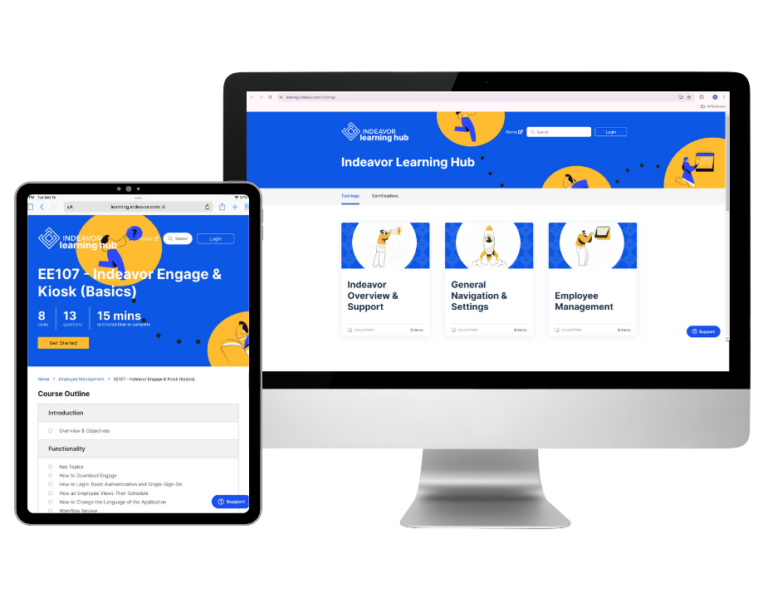
Solutions, like Indeavor, help organizations convert operational knowledge into configured rules and automated processes. When knowledge is built into how work is assigned and managed, gaps shrink, and consistency improves.
Conclusion
A knowledge gap is the difference between what is known and what must be known to perform effectively. Left unaddressed, it leads to inefficiency, risk, and uneven results. Theory shows that information spreads unevenly unless organizations take deliberate action.
The most effective response combines documentation, training, cross-team sharing, and technology-enabled workflows. Organizations that systemize knowledge instead of relying on individuals build stronger, more resilient operations.
About the Author
Claire Pieper is the Digital Marketing Specialist for Indeavor. In her role, she specializes in crafting strategic and engaging content, ensuring that customers are well-informed. Claire is dedicated to enhancing the customer experience and optimizing the user journey through Indeavor’s solutions. To learn more or get in touch, connect with Claire on LinkedIn.
Share this post


