












If you manage shift workers in the UK, your scheduling and HR practices are about to change significantly. The Employment Rights Act 2025 is the most sweeping overhaul of UK employment law in a generation, covering everything from zero-hours contracts to unfair dismissal thresholds. And unlike some legislative packages that arrive with a comfortable runway, several provisions are already active.
This post breaks down what the 2025 Employment Rights Act actually requires, when each phase lands, and what employers managing complex shift patterns need to do right now.
When Do Employment Rights Act 2025 Changes Take Effect?
The UK Employment Rights Act 2025 is phased across 2026 and 2027, which means the pressure is not arriving all at once. But the first deadlines have already passed, and the most operationally significant ones are weeks or months away. The table below maps the key milestones.
| When | Key Changes | What Employers Should Do |
| December 2025 | Royal Assent granted; Act becomes law | Begin internal audit of contracts and scheduling practices |
| February 2026 | Fire and rehire restrictions take effect; protective award doubled | Review planned contract renegotiations and restructuring plans for compliance |
| April 2026 | Enhanced flexible working rights; consultation requirement before refusal confirmed | Update flexible working policy and train line managers on the new process |
| October 2026 | Zero-hours guaranteed hours provision; advance shift notice required | Establish shift notice procedures and update employment contracts for variable-hours workers |
| January 2027 | Day-one unfair dismissal rights; two-year qualifying period removed | Redesign onboarding, probation, and dismissal processes to document fair procedure from day one |
| 2027 TBC | Collective redundancy threshold changes; further secondary legislation expected | Monitor government consultations and revise workforce planning accordingly |
The government publishes ongoing updates on timing. The Employment Rights Bill factsheets are the most reliable source for confirmed implementation dates.
What the Employment Rights Act Changes for Your Workforce
Three areas of the Employment Rights Act 2025 will have the highest operational impact for industries with variable-hours or shift-based workforces. Here is what each one means in practice.
Zero-Hours Contracts Get a New Framework
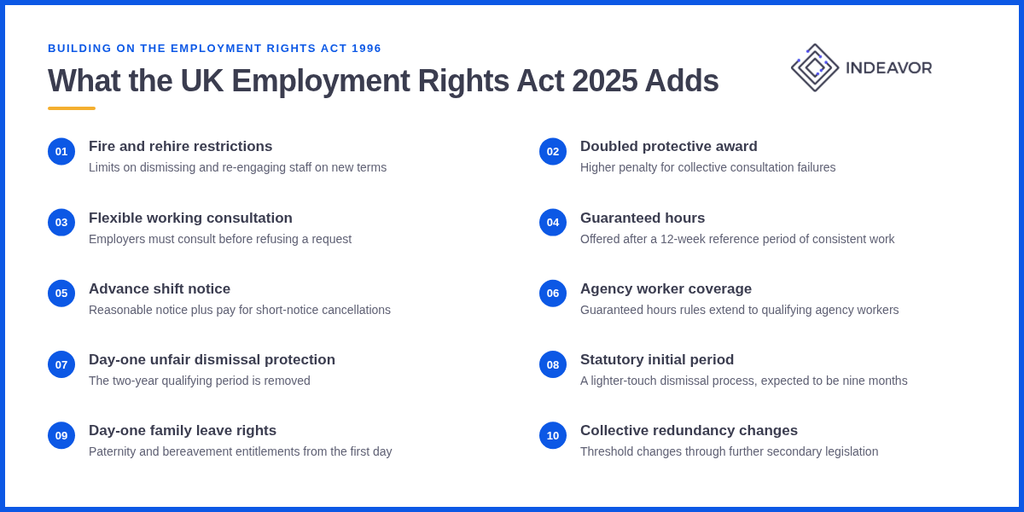
Under the Employment Rights Act 2025, workers on zero-hours contracts or genuinely variable-hours arrangements now have the right to be offered guaranteed hours after a 12-week reference period. If your scheduling data shows a worker consistently working 20 or more hours per week, you will need to offer a contract that reflects that reality.
The Act also requires employers to give reasonable advance notice of shifts and to pay compensation for shifts cancelled at short notice. For shift workers in healthcare, logistics, manufacturing, retail, and hospitality, these rules directly reshape how you plan and communicate rosters.
The practical implications for scheduling teams:
- Track Hours Patterns, Not Just Scheduled Slots: Your system needs to surface who is consistently working and at what volume, not just who is booked this week.
- Formalize Your Shift Notice Standard: Decide how far ahead shifts must be published and build that requirement into manager workflows.
- Document Late Cancellations: If a shift is pulled after the notice window, you need a clear, consistent process for calculating and recording compensation.
- Review Agency Arrangements: Similar guaranteed hours rules apply to qualifying agency workers, so contracts with staffing agencies may also need updating.
Unfair Dismissal Becomes a Day-One Right
Currently, employees need two years of continuous employment before they can bring a claim for unfair dismissal. The Employment Rights Act 2025 abolishes that threshold. From January 2027, protection applies from the first day of employment.
This does not mean you cannot dismiss employees for conduct, capability, or redundancy. It means you need a demonstrably fair process from the outset. The government has confirmed that a lighter-touch statutory procedure will apply during an initial probationary period, expected to be set at nine months, but you must still follow it and provide appropriate notice.
If your current practice relies on the two-year buffer to manage underperforming new hires informally, you need to close that gap well before January 2027. Documenting performance conversations, setting clear expectations during onboarding, and following a consistent review process from week one is no longer optional. It is the minimum standard.
The Employment Rights Act 1996 previously set the foundation for these protections. The 2025 Act builds on and extends that framework significantly.
New Consultation Requirements for Flexible Working Requests
The right to request flexible working was already a day-one right under UK law before the UK Employment Rights Act 2025. But the Act adds teeth. Employers must now consult with the employee before issuing a refusal, and that consultation needs to be meaningful, not a formality.
For teams managing shift workers across complex rotations, this matters more than it might seem. Requests for compressed hours, alternative shift patterns, or reduced hours will come from day one, and your managers need a documented process for evaluating and responding to them fairly and consistently. An informal “no” from a supervisor is no longer adequate.
What the Employment Rights Act 2025 Means for Day-to-Day Operations
The UK Employment Rights Act 2025 is not only an HR compliance project. It has direct implications for how scheduling and operations teams manage workforces at scale.
The biggest friction points tend to emerge in a few predictable places:
- Scheduling Systems Without Pattern Tracking: If your platform cannot show you who has averaged 20 or more hours over a rolling 12-week window, you cannot reliably identify guaranteed hours obligations before they arise.
- Informal Shift Changes: Verbal swaps and last-minute cancellations are now a liability if you cannot produce an audit trail for each one and a record of any compensation owed.
- Inconsistent Onboarding Processes: With day-one unfair dismissal protection on the way, performance management needs to start during induction, not six or twelve months in.
- Reactive Responses to Flexible Working: You need a consistent, traceable workflow for evaluating requests, including the required consultation step, even for employees in their first week.
- Employee Rights UK Compliance Documentation: If a claim goes to tribunal, your scheduling records, shift notices, and contract change history will be the evidence. They need to be complete and accurate.
Indeavor’s employee scheduling platform is built to give managers real-time visibility into hours patterns, shift history, and contract status across large and variable-hours workforces. Combined with our compliance management tools, you get a complete audit trail for every scheduling decision, which is exactly what you need when the two-year qualifying period disappears.
For day-one rights tied to leave and absence, including changes to paternity and bereavement entitlements also included in the Act, our absence management module ensures entitlements are tracked accurately from an employee’s first shift.

Frequently Asked Questions
When does the Employment Rights Act 2025 come into force?
The Act received Royal Assent in December 2025, but most major provisions are being introduced in phases through 2027. Zero-hours guaranteed hours rules took effect in October 2026, and day-one unfair dismissal rights arrive in January 2027. The government maintains a tracker with confirmed dates at Employment Rights Act: Implementation Timeline.
Do zero-hours contract workers have new rights under the Employment Rights Act 2025?
Yes. Workers on zero-hours contracts who regularly work consistent hours will be entitled to a guaranteed hours contract after a 12-week reference period. Employers must also give reasonable advance notice of shifts and compensate workers for late cancellations. These requirements extend to agency workers in comparable arrangements.
How does the Employment Rights Act 2025 change the probationary period rules?
The two-year qualifying period for unfair dismissal will be removed from January 2027. A lighter-touch dismissal process will apply during a statutory initial period (expected to be nine months), but employers must still follow a fair procedure and give notice. Probationary periods remain lawful; they just no longer provide the same buffer from day-one claims.
What does the UK Employment Rights Act 2025 mean for flexible working requests?
The UK Employment Rights Act requires employers to consult employees before refusing a flexible working request. The eight statutory grounds for refusal remain in place, but a refusal now needs to be demonstrably justified following a genuine consultation. For shift-based businesses, this means building a consistent review and response process into your HR workflows from the start of each employment relationship.
The Employment Rights Act 2025 covers more than what is outlined here, but for workforce planners and operations teams managing shift workers at scale, these are the provisions with the highest immediate impact. The phased timeline gives you windows to prepare. Those windows are closing.
Organizations that adapt their scheduling, documentation, and compliance workflows now will find these changes manageable. Those that wait for each deadline to arrive will find the margin for error much thinner.
Ready to align your scheduling and compliance workflows with the UK Employment Rights Act 2025? Contact us to speak with a specialist about how Indeavor supports compliant workforce management across complex shift environments.
Share this post


