









If you run plants, depots, or field crews in more than one state, 2027 is a year when the gap between federal and state labor laws gets wider, not narrower. The Department of Labor put the federal overtime threshold back to its 2019 level. Sacramento passed a dozen new employer rules, Maryland starts collecting paid leave premiums, and more than a dozen states raise their minimum wage on January 1.
This guide covers the federal labor law updates that matter for 2027, the minimum wage changes announced so far, the state laws that affect how you schedule and pay hourly people, and the records you have to keep. It’s written for operations and payroll leaders at industrial employers, not lawyers. Where a rule is still moving, we say so.
Labor laws for employers change on different clocks: federal rules move slowly and mostly through the courts, state rules move every January and some every July. Check your state’s labor agency before you finalize 2027 budgets, and read our related guides on minimum wage by state, meal and rest break laws by state, and PTO payout laws by state for the detail this post doesn’t have room for.
Key Federal Labor Law Updates for 2027
Federal labor laws set the floor for all 50 states: the FLSA for wages, overtime, recordkeeping, and child labor, the FMLA for unpaid leave, Title VII and the ADA for discrimination. None of those statutes changed in 2026. How they’re enforced did.

Federal Paid Leave Program Developments
There is still no federal paid leave program and nothing close to passing. The one live proposal is the More Paid Leave for More Americans Act, a bipartisan bill introduced in July 2026 that would give grants to states that set up their own programs and create a multi-state body to harmonize how they run. It doesn’t create a federal benefit; if it passes, the effect is more state programs, not one national one.
Fourteen states plus D.C. now have or are building mandatory programs. Minnesota and Delaware started paying benefits in January 2026, and Maine in May. For 2027, the two to watch are:
- Maryland: Payroll contributions begin January 1, 2027, at a combined rate of 0.90% of covered wages; benefits start January 2028. Maryland FAMLI has employer guidance.
- Virginia: Enacted a mandatory program in April 2026, with benefits scheduled for 2028. Contribution dates will follow.
If you operate in any of these states, your absence management process needs to handle intermittent state leave alongside FMLA, because the two don’t always run concurrently and the state agency, not you, decides the benefit amount.
Overtime Exemption and Salary Threshold Regulations
This is the biggest federal employment law change since the last version of this article, and it went the opposite way from what most people expected. The 2024 rule that would have raised the white-collar exemption threshold to $58,656 was vacated by a Texas federal court in late 2024. On May 15, 2026, the Department of Labor formally rescinded it and wrote the 2019 numbers back into the regulation.
For 2027, the federal fair labor law overtime exemption threshold is $684 per week, or $35,568 per year, and the highly compensated employee threshold is $107,432. There is no automatic escalator and, as of this writing, no pending federal rulemaking to raise it. A Senate bill to phase the threshold up to $75,000 by 2029 has been introduced but not acted on.
What the rescission means for your exempt classifications
Don’t read this as permission to reclassify people downward:
- State thresholds control where they’re higher. California’s exempt salary floor is $72,384 in 2027, Washington’s is up to $92,196 for large employers, and New York’s is well above $60,000 downstate. The federal number is irrelevant in those states.
- The duties test still applies. Salary alone never makes someone exempt. A shift lead earning $40,000 who spends most of the shift running a line is non-exempt, whatever the title says.
- Anyone you reclassified in 2024 stays reclassified unless you actively change it. If you moved supervisors to hourly ahead of the $58,656 threshold, they’re now entitled to overtime under your own policy. Moving them back is a pay cut, so treat it as a decision, not a cleanup.
Our guide on mandatory overtime laws covers the daily and weekly rules by state, and the overtime calculator will show you what a given shift pattern costs.
Child Labor Laws Are Moving in Two Directions
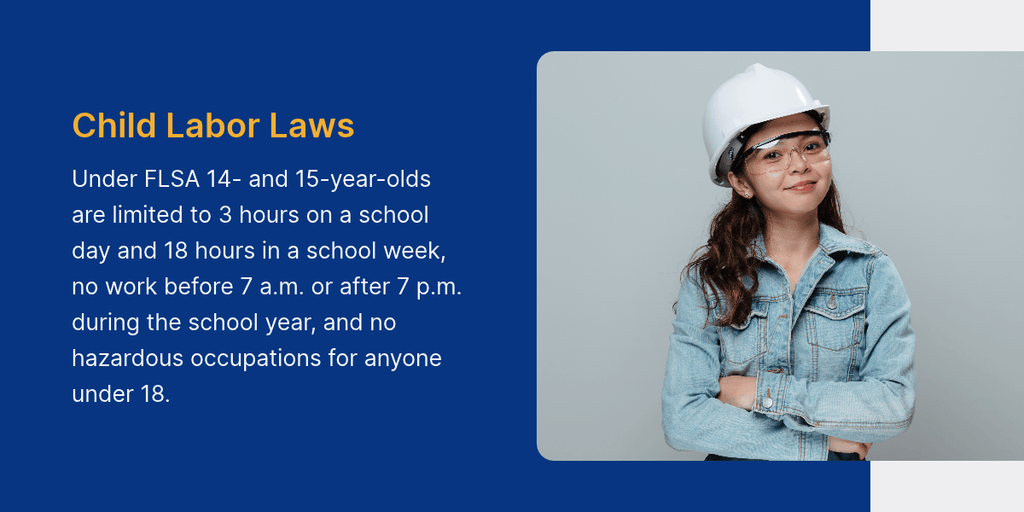
Federal child labor laws under the FLSA haven’t changed: 14- and 15-year-olds are limited to 3 hours on a school day and 18 hours in a school week, no work before 7 a.m. or after 7 p.m. during the school year, and no hazardous occupations for anyone under 18. The DOL’s YouthRules site is the reference.
The states are pulling in opposite directions. According to the Economic Policy Institute, at least 13 states introduced bills in 2026 to loosen youth work rules, and four enacted them. Indiana dropped youth employment registration, Washington doubled the hours minors in work-based learning programs can work, and Nebraska set a lower minimum wage for 14- and 15-year-olds. Oregon went the other way and wrote the FLSA hour limits into state law.
Where state law is weaker than federal, federal applies; where it’s stricter, the state wins. In manufacturing and food processing, the hazardous occupation orders are what get companies fined. Make sure your skills and certification rules in the scheduling system block minors from restricted equipment, not just restricted hours.
2027 State and Local Minimum Wage Increases
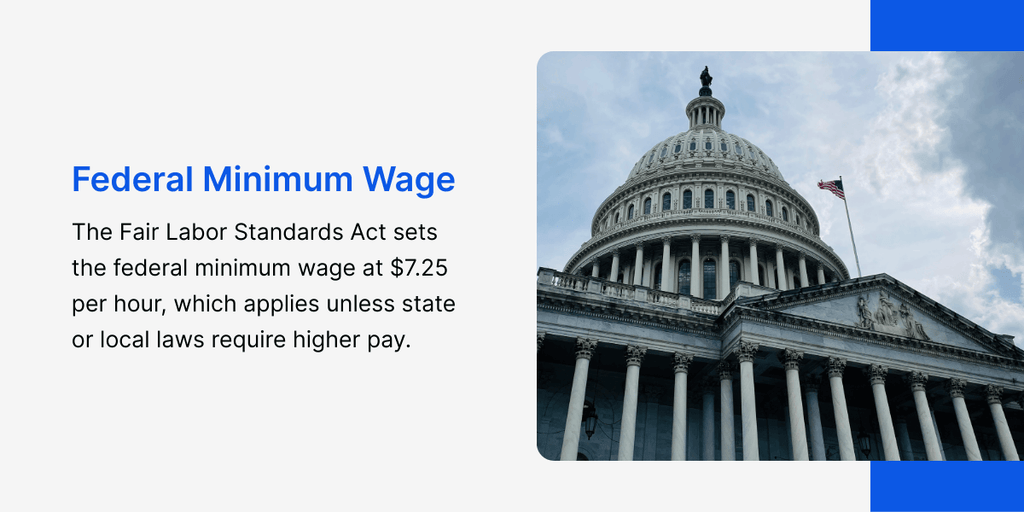
The federal minimum wage is still $7.25, as it has been since 2009. Thirty states and D.C. are above it, and most index to inflation, so January 1 brings a new number every year. The DOL’s state minimum wage page is the authoritative list; our minimum wage by state guide tracks the local rates too.
Here are the January 1, 2027 rates that were fixed by law or announced as of mid-October 2026:
| State | 2026 rate | Jan 1, 2027 rate | Note |
| California | $16.90 | $17.40 | Exempt salary floor rises to $72,384. Fast food and healthcare have higher floors. |
| Washington | $17.13 | $17.73 | Highest state rate. Seattle $22.14. Large-employer exempt multiplier rises to 2.5x. |
| New Jersey | $15.92 | $16.48 | $16.25 for small and seasonal employers; farm workers reach $15. |
| Colorado | $15.16 | $15.71 | Denver, Boulder, and Edgewater are higher. Tipped cash wage $12.69. |
| Michigan | $13.73 | $15.00 | Final step of the 2025 ballot-driven schedule; indexed after this. |
| Virginia | $12.77 | $13.75 | Rises to $15.00 on January 1, 2028. |
| Nebraska | $15.00 | $15.26 | First 1.75% annual step under LB 258; confirm final figure with Nebraska DOL. |
| Ohio | $11.00 | $11.40 | Inflation adjustment. |
| New York | $16.00 / $17.00 | No change | First year of CPI indexing; state confirmed no increase on Jan. 1. Possible mid-year adjustment. |
Connecticut, Maine, Minnesota, Montana, Rhode Island, South Dakota and Vermont also adjust on January 1 and publish rates in the fall. Alaska moves to $15.00 on July 1, 2027; D.C. and Oregon adjust each July 1; Missouri starts CPI indexing in January 2027.
Two things catch multi-site employers every year. Local rates: at least 38 California cities, plus Seattle, Denver and Santa Fe, sit above their state rate, and an employee who floats between two sites can trigger two minimums in one week. And knock-on effects: exempt salary floors, tipped cash wages and youth rates all move with the base rate. Washington’s large-employer exempt floor jumps from $80,168 to $92,196 in one step because the multiplier and base rate changed together.
Build the January 1 change into the schedule before the holiday freeze. Rate tables that update on the first pay period including January 1 are the most common fix auditors ask for.
State-Specific Labor Law Changes in 2027
Most state employment law changes take effect on January 1. These are the ones that change how you schedule, pay, or track hourly people, not every bill in every state.
California
California labor laws are the leading indicator for the rest of the country, and the 2026 session was a heavy one. Beyond the $17.40 minimum wage, the laws below take effect January 1, 2027 unless noted. Our California compliance guide covers the existing rules on daily overtime, meal premiums, and split shifts.
AI, automated decisions and workplace surveillance
SB 947, the “No Robo Bosses Act” (effective July 1, 2027), bars using automated decision systems to infer protected characteristics, to retaliate, or in ways that violate labor or safety law. AB 1331 prohibits surveillance in bathrooms, and a companion bill restricts tools that read emotional state or neural data. SB 951 adds Cal-WARN notice content for layoffs caused by AI or automation. If your scheduling or attendance system uses automated scoring, document how it works before January. Hanson Bridgett’s summary is a good starting point.
Leave, pay data and stay-or-pay agreements
SB 1149 extends bereavement leave to a “designated person,” mirroring sick leave. SB 1237 raises penalties for repeated pay data filing failures. AB 1697 delays the “stay-or-pay” ban to contracts signed on or after January 1, 2027, with new exceptions for bonus repayment. Harassment-prevention training will have to cover anti-hate content from January 1, 2028, under AB 1803. CDF Labor Law’s list has every bill number.
Colorado
Colorado’s updated labor laws include a rewritten AI law, SB 26-189, which takes effect January 1, 2027. It replaces the heavier 2024 law: no more formal risk programs, but employers using automated tools that materially influence hiring, pay, or discipline must give notice before use, offer a chance to correct the record and a human review of adverse decisions, and keep records for three years. FAMLI added up to 12 weeks of leave for parents of infants in the NICU in 2026, and the minimum wage goes to $15.71. Break rules are unchanged; see our break laws by state guide.
Washington
Beyond the $17.73 minimum wage and the higher exempt threshold, Washington’s paid leave program changes how premiums are split between the family and medical portions in 2027, which shifts employer contributions. Noncompete clauses are barred from July 2027. The L&I announcement has the full 2027 numbers, including the $15.07 youth rate.
Other states to watch
Illinois. Three laws land January 1, 2027: menopause becomes a protected characteristic under the Human Rights Act, employers with more than 25 employees must pay regular wages for jury duty, and job postings can’t require a driver’s license unless driving is an essential function. Hinshaw’s summary covers all three. The $15.00 minimum wage is unchanged.
Connecticut. The paid sick leave expansion reaches its final step on January 1, 2027, when it applies to employers with even one employee in the state. Accrual is one hour per 30 hours worked.
Maryland. FAMLI contributions begin January 1, 2027, as covered above. Employers with fewer than 15 employees (counting out-of-state staff) remit only the employee half; everyone else pays the full 0.90%, split evenly.
Rhode Island. Wage replacement under the TCI and TDI programs rises from 60% to 70% in 2027.
Texas. No change, which is the point. Texas labor laws largely defer to federal: the minimum wage is $7.25, there’s no state daily overtime, no state paid sick leave mandate, and no meal break requirement. Employers follow the FLSA and the Texas Payday Law on timing of wages. Don’t assume Texas rules travel; a Texas shift template won’t work in California.
Recordkeeping: What Employers Must Retain
Every wage claim starts with a records request, and the burden shifts to the employer if records are incomplete. Under the FLSA, employers must retain these documents for at least three years: payroll records, collective bargaining agreements, and sales and purchase records. Time cards, schedules, wage rate tables, and anything else used to compute pay must be kept for two years. DOL Fact Sheet #21 has the full list.
States go further: California requires three years of wage statements, New York six years of payroll records, and Minnesota’s new break law makes missed-break records evidence in a double-damages claim. The practical standard: keep schedules as published, schedules as worked, break records, and every rate table with its effective date, for the longest period any state you operate in requires. A time and attendance system that stores the published schedule next to the punched hours does most of this for you.

How Automated Workforce Management Software Ensures Ongoing Compliance
The pattern is obvious by now. The rules differ by state, change every January, and interact: a minimum wage change moves the exempt threshold, which changes who gets overtime, which changes what you owe on a missed meal break. Nobody can hold that across 20 sites, and supervisors building schedules at 5 a.m. shouldn’t have to.
Indeavor’s compliance management tools let you encode the rules once, by state, site, and union contract, and have every schedule checked against them before it’s published:
- Rate tables with effective dates so January 1 changes apply to the right pay period automatically
- Break, rest, and daily overtime rules by jurisdiction, flagged before the shift rather than in a wage claim
- Exempt and non-exempt classification carried into scheduling, so hourly supervisors get overtime calculated correctly
- Minor work restrictions on hours and equipment, enforced at assignment
- Leave integration so state paid leave, FMLA, and CBA leave are tracked together and backfilled correctly
The employee scheduling and overtime management modules do the day-to-day work; the audit trail is a byproduct. The same engine that keeps you compliant also stops unplanned premium hours, which is where food processing and automotive customers see the payoff first. Our guide on excessive overtime in manufacturing goes into that side of it.
Frequently Asked Questions About Labor Laws
What are the three most important HR laws?
The most important HR labor laws are FLSA (wages, overtime, child labor, recordkeeping), Title VII (discrimination and harassment), and the FMLA (job-protected leave). OSHA is a close fourth for industrial employers.
What are the major labor laws in the USA?
The core federal employment laws in the United States are the FLSA, Title VII, the ADA, the ADEA, the FMLA, the Occupational Safety and Health Act, the National Labor Relations Act, the Equal Pay Act, and the Employee Retirement Income Security Act. I-9 verification and the WARN Act round out the list.
What happens when you file a complaint with the US Department of Labor?
The Wage and Hour Division may open an investigation: a records request covering two to three years, employee interviews, and a review of pay practices. If violations are found, the employer pays back wages and may owe an equal amount in liquidated damages. Retaliating against the employee who filed is itself a violation. The DOL explains the process on its site.
What are child labor laws and when did they start?
The rules limiting hours, times of day, and types of work for employees under 18. Federal rules date to the FLSA of 1938; many states had earlier laws and still set stricter limits.
What states are right-to-work states?
Twenty-six states have right-to-work laws, which bar requiring union membership or dues as a condition of employment: most of the South, the Plains and Mountain West, plus Indiana, Iowa and Wisconsin. Michigan repealed its law in 2024. The National Right to Work Foundation keeps a current list. Right-to-work status doesn’t change your wage and hour obligations.
What states are at-will states?
At-will means either party can end the relationship at any time for any lawful reason; every state recognizes exceptions for discrimination, retaliation, and public policy. Every state except Montana, which requires good cause after a probationary period, is an at-will state.
What are the five major kinds of employment laws?
The usual grouping is wage and hour (pay, overtime, breaks), anti-discrimination, workplace safety, leave and benefits, and labor relations (unions and collective bargaining). Most of the employment law changes in this article fall into the first and fourth categories.
None of the 2027 labor law changes is dramatic alone. Together, they’re a lot of rate tables, thresholds, and policies to update in the same two-week window, across every site, before the first payroll of the year. The employers who get it right treat labor law compliance as a scheduling problem, not a legal one, and fix it in the system that builds the shifts.
If you’d like to see how Indeavor handles multi-state rules, state paid leave, and 2027 rate changes in one place, book a demo and bring your messiest site.
This article is for informational purposes only and is not legal advice. Labor laws change frequently. Confirm current requirements with your state labor agency or employment counsel before updating policy.
Share this post