




In a food processing plant, a hospital, or a power plant, most of the workforce never opens a company inbox. People clock in, move to a line, a ward, or a route, and clock out. Yet most HR communication is still designed for employees with a laptop, a corporate email address, and quiet time to read it. That mismatch is not a presentation problem. It is an operational one.
Gallup’s research found that global employee engagement fell to 20% in 2025, its lowest level since 2020, at an estimated cost of $10 trillion in lost productivity worldwide. In 24/7 operations, a meaningful share of that cost traces back to information that never reached the people doing the work. Building HR communication that actually lands on the frontline is one of the highest leverage moves a people team can make.
Why HR Communication Breaks Down on the Frontline
The policy update. The benefits reminder. The safety notice. The shift change alert. All written. Not all received.
The failure is distribution. Strong HR communications start from where people actually are, not from where the message originates. When communication in the workplace assumes a desk, a screen, and a spare ten minutes, it quietly excludes the majority of an industrial workforce.
The cost shows up in operational metrics long before it shows up in an engagement survey. A missed vacancy notification becomes an uncovered shift and unplanned overtime. A delayed safety update becomes an incident. A benefits deadline that never reached the night shift becomes a compliance conversation. Poor communication from HR is expensive precisely because the expense is recorded somewhere else, under labor cost, absenteeism, or attrition.
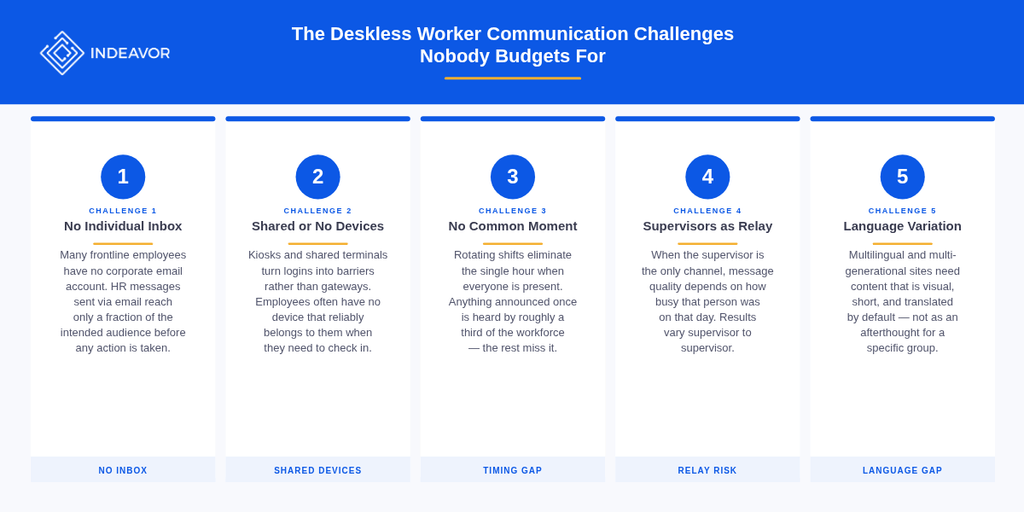
The Deskless Worker Communications Challenges Nobody Budgets For
Deskless worker communication breaks for structural reasons, not attitudinal ones:
- No Individual Inbox: Many frontline employees have no corporate email account at all, so email-based HR communications reach a fraction of the intended audience.
- Shared or No Devices: Kiosks and shared terminals mean logins become a barrier rather than a gateway.
- No Common Moment: Rotating shifts remove the single hour when everyone is present, so anything announced once is heard by roughly a third of the workforce.
- Supervisors as the Only Relay: When the frontline supervisor is the sole channel, the message quality depends entirely on how busy that person was on that day.
- Language and Reading Variation: Multilingual and multigenerational sites need visual, short, and translated formats by default.
Each of these challenges is solvable, but only if human resources communications are designed around access rather than around what is convenient to send. Treating deskless worker communication as a distribution problem, not a writing problem, is the shift that makes the rest of the work possible.
How Do Companies Communicate with Frontline Deskless Employees?
Organizations with strong HR communication use a small number of channels tied to moments that already exist in the working day. The most common combination includes SMS and automated voice calls to personal phones, a mobile scheduling app, screens at entry points and break areas, printed notices at time clocks, and structured shift briefings delivered by supervisors who have been given the message in writing first.
The pattern is consistent. Effective frontline communication travels to the employee rather than waiting for the employee to come looking for it. That single principle separates communication with an hourly workforce that works from communication that only looks complete on a project plan.
Channel choice is also a culture signal. When deskless worker communication runs on the same tools leadership uses for its own updates, employees read that as parity. When it runs on a noticeboard, they read that too.
Why the Gap Lands Hardest on HR
HR is regularly named among the more stressful corporate functions, and HR communication load is one of the reasons. HR teams absorb the friction created when information fails to move. Every repeated question, every escalation, and every rumor that fills the space a missing message left behind eventually arrives at their desk, usually once it has already become a problem. Fixing distribution at the source is one of the most reliable ways to reduce that pressure, because well-designed HR communications remove work rather than create it.
How to Improve Employee Communication on the Frontline
An effective HR communication strategy for deskless teams comes down to three decisions: where messages land, how they are written, and how you know they arrived.
Build the HR Communication Strategy Around Access, Not Preference
Start with an audit rather than a tool. List every recurring message HR sends over a quarter, then record who it needs to reach, how urgent it is, and which channel currently carries it. Most teams find that a small number of high-urgency messages, such as shift changes, vacancies, and safety alerts, are travelling on the slowest channels available.
Then attach HR communication to the work itself. Frontline employee communication performs best when it is embedded in the systems people already use to see their schedule, request leave, or pick up an open shift. That is why notifying employees of shift changes through the same platform that generates the schedule outperforms a separate announcement sent after the fact.
Frontline worker communication platforms should be judged on reach before features. HR communication tools that require an app download, a corporate login, or a personal device policy will systematically exclude part of the population they are meant to serve. Solutions such as Indeavor Connect deliver targeted texts and automated voice calls filtered by shift, job, or facility area, with no download required, while the Indeavor Engage app gives employees direct visibility into their own schedules. Organizations using Indeavor report a 77% improvement in schedule visibility, which removes an entire category of avoidable questions from the supervisor’s day.
Write Every Message to the 5 C’s
Communication is one of the 7 C’s of HR, alongside competence, commitment, contribution, compliance, creativity, and culture. Versions of the model differ, but communication sits in all of them, and it is the C that decides whether the other six ever reach the floor.
The 5 C’s of effective communication set the bar for the message itself: clear, concise, coherent, correct, and courteous. As a quality filter for communication in HR, the first two carry most of the weight on a production floor. If a message cannot be understood in fifteen seconds between a line and a locker room, it fails regardless of how well it is written. The working standard for any employee communications strategy aimed at shift-based teams is narrower than most drafts allow: one message, one action, one owner, one deadline.
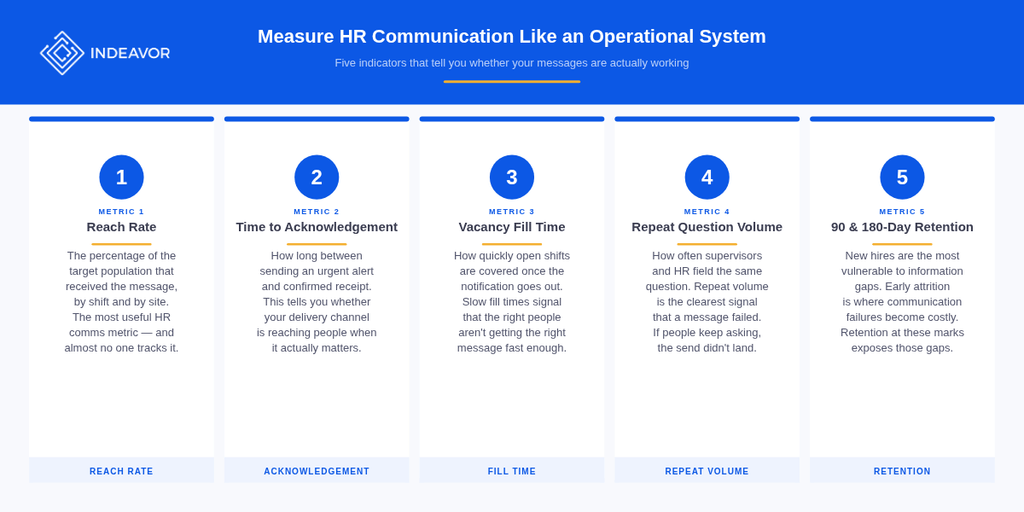
Measure HR Communication Like an Operational System
HR communication is one of the few areas where teams still report activity instead of outcomes. Messages sent is not a metric. Consider tracking a short set of indicators instead:
- Reach Rate: The percentage of the target population that actually received the message, by shift and by site. This is the single most useful HR communications metric and almost nobody tracks it.
- Time to Acknowledgement: How long between sending an urgent alert and confirmed receipt.
- Vacancy Fill Time: How quickly open shifts are covered once notified.
- Repeat Question Volume: How often supervisors and HR field the same question, which is the clearest signal of a message that failed.
- Retention at 90 and 180 Days: New hires are the most vulnerable to information gaps, and early attrition is where communication failures become expensive.
Workforce data makes this measurable. Workforce analytics can connect communication patterns to absenteeism, overtime concentration, and coverage gaps, which turns HR communication from a soft topic into a business case with numbers attached. It is also how this work links to retention outcomes; organizations that address the operational root causes of disengagement have reported meaningful improvements in employee engagement and retention, including a 47% reduction in attrition among Indeavor customers.
HR Communication Is Infrastructure, Not Messaging
The organizations that get this right stop treating HR communication as a series of announcements. They design for access, attach information to the work, and measure whether it landed.
Where Communication Sits in the 5 P’s of HR Strategy
The 5 P’s of HR strategy are purpose, principles, processes, people, and performance. The framework is a useful reminder that human resource communication is not a standalone workstream sitting alongside the others. It is the mechanism that carries purpose and principles into daily operations, and it either supports or undermines every process the people function owns, from onboarding to culture. When HR communications fail to reach the floor, the strategy fails quietly, one shift at a time.
Done consistently, HR communication stops being a broadcast channel and starts functioning as an operating system for the workforce. That is what separates successful HR communication strategies from a well-intentioned email nobody read.
If you want to see how targeted HR communication works inside a scheduling platform built for frontline operations, request a demo.
Share this post