











Every unplanned stop on a production line has a cost. Lost output, rushed repairs, overtime to catch up, and scrap from a line that restarts cold. Total productive maintenance exists to stop that cycle before it starts by making equipment care part of everyone’s job, not a task that waits for a breakdown.
But a TPM program is only as strong as the schedule behind it. Operators can’t run daily inspections when they’re pulled to cover a short line. Planned maintenance windows slip when no qualified technician is on shift. And the training that holds the whole program together gets pushed back week after week.
For manufacturing operations, that makes workforce scheduling a maintenance issue as much as a labor one. Read on to learn what TPM is, how its core pillars work, and how strategic scheduling keeps your maintenance strategy on track.

What Is Total Productive Maintenance (TPM)?
Total productive maintenance is a maintenance philosophy that makes equipment care a shared responsibility across production, maintenance, and management. Instead of waiting for something to break, operators and technicians work together to prevent losses before they happen.
The approach grew out of Japanese manufacturing. Toyota supplier Nippondenso was an early adopter, and the Japan Institute of Plant Maintenance formalized the framework in 1971.
The goal is often summarized as perfect production:
- Zero breakdowns
- Zero stops, including small stops and slow running
- Zero defects
Many programs add a fourth goal of zero accidents. The payoff can be significant. According to the U.S. Environmental Protection Agency, most companies can realize a 15% to 25% increase in equipment efficiency rates within three years of adopting TPM.
Plants track that progress through overall equipment effectiveness (OEE), which measures how much planned production time is truly productive.
Core Pillars of Total Productive Maintenance
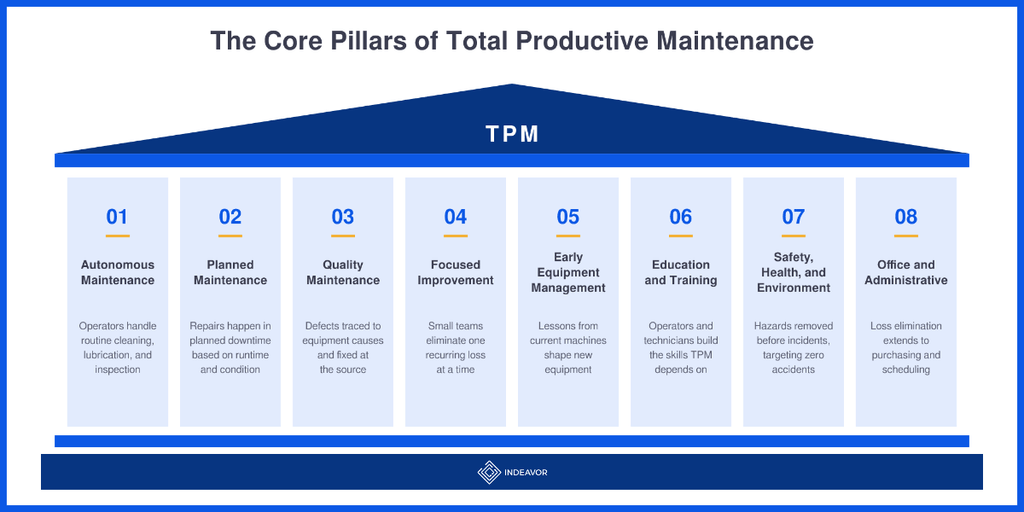
The traditional framework rests on eight pillars, with 5S workplace organization as the foundation. Three of them shape what happens on the plant floor every day, and every one of them depends on having the right people on shift.
Autonomous Maintenance
This pillar moves routine equipment care to the operators who run the machines. Cleaning, lubrication, tightening, and visual inspection become part of each shift’s routine. Operators notice a new vibration or a small leak long before a scheduled inspection would.
The scheduling impact is direct. Operator-led care takes time, even if it’s a short pre-shift routine. When shifts are staffed to the bare minimum, those checks are the first thing to go.
Planned Maintenance
Planned maintenance schedules work based on runtime, equipment condition, and failure history, so repairs happen during planned downtime instead of mid-run. The goal is zero breakdowns at the lowest practical cost.
A maintenance calendar only works when a qualified technician is available for every task on it. Aligning maintenance windows with labor plans keeps work orders from getting bumped when a crew comes up short.
Quality Maintenance
Quality maintenance traces defects back to the equipment conditions that cause them, then fixes those conditions at the source. It targets zero defects through prevention rather than end-of-line inspection.
That depends on consistency. When the person running a machine knows its set points and inspection standards, small drifts get caught before they turn into scrap.
Focused Improvement and the Remaining Pillars
The other five pillars round out the framework:
- Focused improvement (kaizen): Small cross-functional teams attack one recurring loss at a time, building a culture of continuous improvement.
- Early equipment management: Lessons from existing machines shape how new equipment is designed, purchased, and installed.
- Education and training: Operators, technicians, and managers build the skills every other pillar depends on.
- Safety, health, and environment: Hazards are removed before they cause incidents, with zero accidents as the target.
- Office and administrative: Loss-elimination thinking extends to purchasing, scheduling, and other support work.
Of these, education and training deserve a closer look, because it sustains everything else.
The Education & Training Pillar
The education and training pillar makes sure every employee has the skills to carry out their part of the TPM program. Without it, inspections get done poorly, maintenance work falls to the same few experts, and early gains fade.
The methodology is straightforward:
- Define the knowledge and skill sets each job requires, along with the number of employees needed.
- Assess what you have against what you need.
- Build a training plan or hiring strategy to close the gap.
- Provide continuous skills development for current and future employees.
Building Operator Maintenance Competencies
Operators are the first line of defense in any TPM effort. Training them to inspect equipment, read set points, and flag abnormalities turns every shift into an early warning system.
Cross-skilling multiplies that value. When operators are qualified on several machines, a single absence no longer leaves a line without someone who knows its inspection routine. Cross-trained crews also give supervisors more options when filling open positions.
Qualification management is the foundation. Centralized access to every employee’s certifications and training records makes it clear who is qualified for which task. Rotating employees through the positions they’re qualified for keeps those skills fresh, so you avoid paying to retrain people who haven’t used a skill in months.
Scheduling Workforce Training Without Disrupting Production
Training is easy to defer and expensive to skip. The challenge is finding time for it without leaving lines short. A few practices help:
- Plan training around known low-demand periods and planned downtime.
- Pair trainees with experienced operators on live shifts so learning happens on the job.
- Track certification expiration dates and schedule refreshers before they lapse.
- Stagger training so no single shift loses too many qualified people at once.
- Balance short-term needs, like who is best for a job today, against long-term goals, like building skill depth across your workforce.
Best Practices for Integrating Scheduling with TPM
Scheduling preventive maintenance alongside daily production is where many programs stall. These steps help maintenance and operations work from the same plan.
- Map maintenance tasks to labor requirements. For every recurring task, list the skills, certifications, and headcount it needs.
- Build maintenance windows into the master schedule. Treat planned downtime and pre-shift checks as fixed blocks, not leftovers.
- Protect operator time for equipment care. Staff shifts so a few minutes of inspection don’t come at the expense of output targets.
- Match qualified people to every task. Assign work based on skills, availability, and hours worked to reduce errors and fatigue.
- Plan coverage for absences. Keep a cross-trained bench so a single call-out doesn’t cancel a maintenance window.
- Measure the results. Compare equipment effectiveness and downtime before and after scheduling changes to see what’s working.

The Indeavor Solution
Indeavor helps manufacturers schedule the people behind their maintenance strategy. Our workforce management platform coordinates shift scheduling with equipment maintenance routines, so the right qualified person is in the right place at the right time.
Automated Labor Scheduling Aligned with Maintenance Cycles
With automated employee scheduling, you can assign employees based on an integrated skills matrix in minutes. Qualification and skills management is built into the point of scheduling, so every maintenance task goes to someone trained to do it.
Centralized certification records let you search by skill or date last worked and get notified before qualifications expire. Planned maintenance windows, pre-shift inspections, and training sessions become part of the schedule rather than work squeezed in around it. Organizations without a qualification management system can use Indeavor as one, or integrate the system they already have.
Real-Time Visibility to Eliminate Unplanned Downtime
When a technician calls out, or a line goes down, supervisors need to know who can cover right away. Indeavor provides real-time visibility into who is on shift, who is qualified, and who is available to fill a gap. Through the employee scheduling app, workers can view schedules, pick up open shifts, and request swaps, so coverage gaps get filled before they turn into missed maintenance.
Workforce analytics connect scheduling data to operational results, helping you spot patterns like recurring call-outs on maintenance days. And by integrating with your HCM and ERP systems, Indeavor makes your schedule a working part of your total productive maintenance strategy.
Ready to see how strategic scheduling supports your TPM goals? Request a demo to see Indeavor in action.
Frequently Asked Questions
What is total productive maintenance (TPM)?
Total productive maintenance (TPM) is a proactive maintenance strategy that makes equipment care a shared responsibility across operators, technicians, and management. Its aim is to eliminate breakdowns, stops, and defects.
What is the main purpose of TPM?
The main purpose is to maximize equipment productivity by eliminating losses. That means preventing breakdowns, minor stoppages, slow running, and defects before they happen, while improving equipment reliability and workplace safety.
How to calculate total productive maintenance (TPM)?
TPM itself isn’t a single number. Results are measured mainly through OEE, supported by metrics such as mean time between failures (MTBF), mean time to repair (MTTR), and the ratio of planned to unplanned maintenance work.
What are the 8 pillars of TPM?
The eight pillars are autonomous, planned, and quality maintenance, plus focused improvement, early management of new equipment, education and training, safety, health, and environment, and office and administrative work. All of them rest on a 5S foundation.
What is overall equipment effectiveness (OEE)?
It measures the percentage of planned production time that is truly productive. A perfect score of 100% means producing only good parts, as fast as possible, with no stop time.
How to calculate (OEE) overall equipment effectiveness?
The overall equipment effectiveness formula multiplies three factors: availability × performance × quality. Availability is the share of planned time the equipment actually runs. Performance compares actual speed to ideal speed. Quality is the share of good units out of total units produced. For example, 90% availability, 95% performance, and 99% quality produce a score of about 85%.
Share this post