











A second shift supervisor posts next week’s schedule on Thursday afternoon. By Friday, three operators have asked for swaps, one has quietly started applying elsewhere, and the overtime list is already longer than last month. None of this shows up in an annual survey, but all of it is engagement.
For HR and operations leaders in manufacturing, utilities, and other operations that run on shifts, knowing how to improve employee engagement is not a culture project that lives in a slide deck. It is an operational discipline. On the frontline, engagement is shaped by whether schedules are predictable, whether overtime is distributed fairly, whether people can reach their manager without checking a bulletin board, and whether good attendance is ever noticed.
This guide covers what engagement really means for frontline teams, why it matters to cost and safety, what drives disengagement, and how to improve employee engagement with strategies built for people who never sit at a desk.
What Is Employee Engagement?
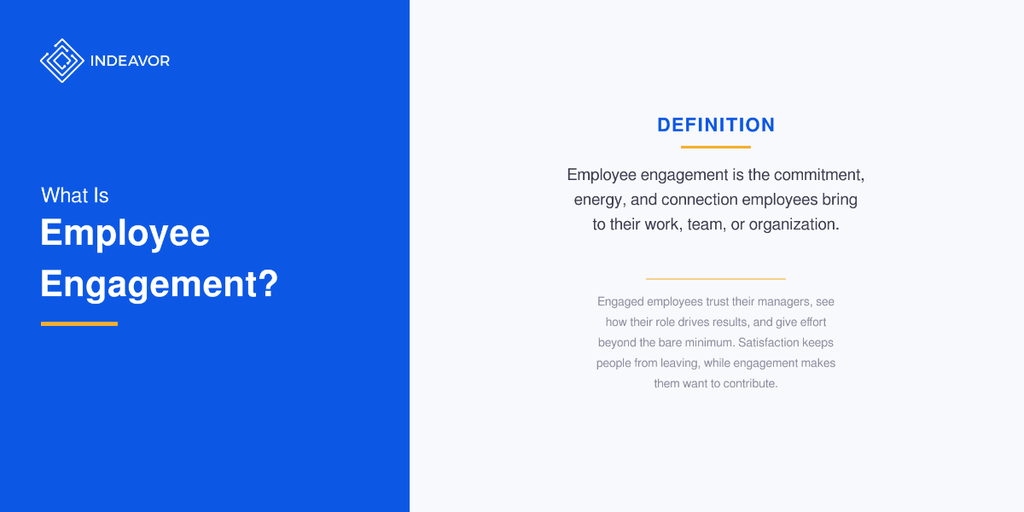
Employee engagement is the level of commitment, energy, and connection employees bring to their work, their team, and their organization. Engaged employees understand how their role contributes to results, trust their managers, and choose to give discretionary effort rather than doing only the bare minimum.
Engagement is not the same as satisfaction. A worker can be satisfied with their pay and still be disengaged because their schedule changes without warning or their ideas are overlooked. Satisfaction keeps people from leaving. Engagement makes them want to contribute.
One widely used way to frame engagement is the 5 C’s of employee engagement:
- Care
- Connect
- Coach
- Contribute
- Congratulate
Managers show they care about people as individuals, connect daily tasks to the bigger picture, coach for growth, value each person’s contribution, and celebrate success. On a plant floor, each C maps to something concrete. Care looks like a schedule that respects rest. Congratulate looks like recognizing the operator who covered a tough shift.
For frontline teams, engagement shows up in concrete behaviors: picking up an open shift, flagging a safety hazard, helping a new hire without being asked, and showing up on the days that are hardest to staff. Employee commitment of this kind cannot be mandated. It is earned through the daily experience of work, which is why understanding it is the first step in learning how to improve employee engagement.
Why Employee Engagement Matters for Industrial and Enterprise Operations
Among recent employee engagement statistics, one stands out for operations leaders. Gallup’s 2026 global workplace data shows that only 20% of employees worldwide were engaged in 2025, and engagement was lowest, at 17%, among on-site employees whose work cannot be done remotely. That describes most of the plant floor.
The importance of employee engagement for these teams comes down to three operational outcomes, and each one has a direct line to cost. Leaders who see that link clearly are better placed to decide how to improve employee engagement where it pays off most.
Reducing Costly Turnover and Absenteeism
Every unplanned absence on a production line triggers a chain reaction. A supervisor scrambles for coverage; someone is held over or called in on overtime, and fatigue rises for the people who are already there. Turnover multiplies the problem, because every departure means recruiting, onboarding, and weeks of reduced output while a new hire gets up to speed.
Gallup’s research on engagement and business outcomes found that teams in the top quartile for engagement saw 81% lower absenteeism than teams in the bottom quartile, along with 18% lower turnover in organizations where turnover is typically high. For hourly workforces, those gaps translate quickly into dollars.
Retention on the frontline comes down to fundamentals that shift workers notice immediately. The three R’s of employee retention are respect, recognition, and reward: people stay when they feel respected, see their contributions acknowledged, and believe they are rewarded fairly. Each of those is shaped as much by how schedules, overtime, and time off are managed as by pay. For hourly teams, getting these fundamentals right is one of the clearest paths to higher ROI from engagement and retention efforts.
Boosting Workplace Safety and Compliance Adherence
Disengaged workers are more likely to cut corners, skip steps, and stay quiet about hazards. Fatigue makes it worse. OSHA notes that long work hours and irregular shifts may increase the risk of injuries and accidents, which makes fair overtime distribution and adequate rest between shifts engagement issues as much as safety ones.
The same Gallup research links top quartile engagement with 64% fewer safety incidents. In regulated environments such as nuclear power, where fatigue management is tightly controlled, as well as food processing and life sciences, engagement also supports compliance, because people who trust a process are more likely to follow it. Across all of these industries, a well-rested and engaged crew is the first line of defense against both incidents and violations.
Improving Operational Efficiency and Team Productivity
Engaged teams waste less time. They communicate clearly at handoffs, cover for each other, and solve small problems before they become downtime. If you are asking how to improve employee productivity on the floor, engagement is usually a stronger lever than another efficiency mandate, because output follows people who care about the result.
Gallup’s research also ties top quartile engagement to 41% fewer quality defects. Operationally, engagement often shows up first in overtime spend. When the same people are repeatedly held over or called in, fatigue and frustration build, and output suffers. In food processing, for example, producers have turned to flex scheduling to reduce overtime and spread the workload more evenly. Whatever the industry, schedule design and engagement reinforce each other: a fairer schedule produces a more committed crew, and a committed crew makes the schedule easier to fill.
Key Factors Driving Employee Disengagement
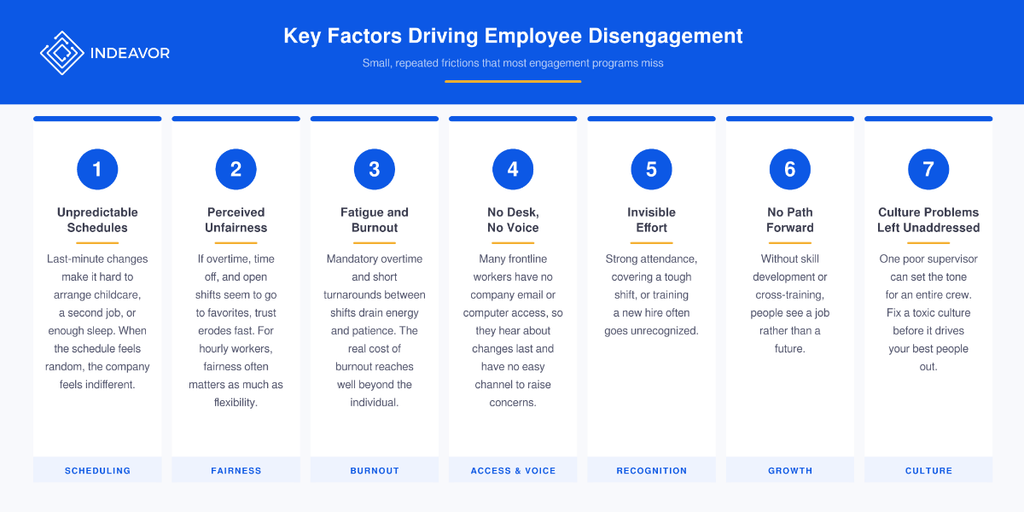
What causes lack of engagement at work? On the frontline, the most common causes are unpredictable schedules, perceived unfairness, fatigue from excessive overtime, poor communication, lack of recognition, and no clear path for growth.
Disengagement rarely comes from one big failure. It builds from small, repeated frictions that most staff engagement programs, designed with office employees in mind, tend to miss. Any plan for how to improve employee engagement has to start with these root causes.
- Unpredictable Schedules: Last-minute changes make it hard to arrange childcare, a second job, or simply enough sleep. When the schedule feels random, the company feels indifferent.
- Perceived Unfairness: If overtime, time off, and open shifts seem to go to favorites, trust erodes fast. For hourly workers, fairness often matters as much as flexibility.
- Fatigue and Burnout: Mandatory overtime and short turnarounds between shifts drain energy and patience. The real cost of employee burnout reaches well beyond the individual.
- No Desk, No Voice: Many frontline employees have no company email or computer access, so they hear about changes last and have no easy channel to raise concerns. Technology accessibility on the frontline is still a gap in many operations.
- Invisible Effort: Strong attendance, covering a tough shift, or training a new hire often goes unrecognized.
- No Path Forward: Without skill development or cross-training, people see a job rather than a future.
- Culture Problems Left Unaddressed: One poor supervisor can set the tone for an entire crew. Learn how to change a toxic work culture before it drives your best people out.
Notice that most of these causes are operational, not emotional. That is good news, because operational problems can be fixed with better processes.
Actionable Strategies to Improve Employee Engagement
How to improve employee engagement on frontline teams: give people predictable, fair schedules and real control over their shifts, communicate in both directions through channels they can actually reach, recognize attendance and effort consistently, and invest in skill development. Then measure results through operational metrics, not surveys alone.
The five employee engagement strategies below are built for shift work, where generic employee engagement ideas like office perks and quarterly town halls tend to fall flat. Each one includes an action step you can start this month.
1. Ensure Schedule Predictability and Shift Flexibility
Ask any shift worker how to improve employee engagement, and the answer usually starts with the schedule. Predictability is the foundation. Publish schedules as far in advance as operations allow, keep rotations consistent, and reserve last-minute changes for genuine emergencies. When changes are unavoidable, notify affected employees directly and right away.
Flexibility builds on that foundation. Shift swapping, open shift pickup, and shift bidding give employees control without sacrificing coverage, as long as rules for qualifications, rest periods, and overtime limits are enforced automatically. This is where scheduling technology makes shift flexibility practical at scale, rather than a favor supervisors grant case by case. And because every swap and pickup follows the same rules, employees see that the system is fair and consistent, which is what turns flexibility into trust.
Action step: Track how often posted schedules change within 72 hours of a shift. If that number is high, start there.
2. Provide Transparent Workforce Communication That Flows Both Ways
Frontline employees need to hear about changes before they happen, in plain language, on a device they already carry. Text alerts, mobile notifications, and shift start huddles reach people that intranet posts and email newsletters never will.
Communication also has to flow upward. Short pulse surveys, suggestion channels, and regular supervisor conversations create genuine employee participation, but only if people see action on what they share. Close the loop publicly: “You told us this, so we changed that.” For deskless teams in particular, HR communication works best when it meets people where they already are, on the floor and on their phones, rather than in an inbox they rarely check.
Action step: For every survey you run, announce at least one visible change within 30 days.
3. Empower Employees With Mobile Self-Service Tools
Self-service is respect in practical form. When employees can view schedules, request time off, swap shifts, and check leave balances from their phones, they stop depending on a supervisor’s availability or a printed roster. Supervisors, in turn, spend less time on administrative requests and more time coaching.
Our employee scheduling app was designed for workers who never sit at a desk, giving them live schedule visibility and self-service from anywhere. The engagement benefit is subtle but powerful. Every request that resolves in minutes instead of days tells employees their time matters. For many operations, self-service is the simplest answer to how to improve employee engagement without adding supervisor workload.
Action step: Count how many schedule and time-off requests still require a paper form or an
in-person conversation. Each one is a candidate for self-service.
4. Recognize Contributions and Reward High Attendance
Recognition is one of the most underused levers on the frontline, partly because supervisors are stretched and partly because effort is hard to see without data. Fix both. Use attendance and scheduling data to identify the people who reliably pick up open shifts, maintain strong attendance, or step in when coverage falls short.
Then recognize them consistently: shoutouts at shift huddles, attendance milestones, priority in shift bidding, or small rewards tied to clear criteria. Transparent criteria matter, because recognition that feels arbitrary does more harm than good.
If you need a starting point, these are the top 5 employee engagement activities for shift teams:
- Shift start huddles that share priorities, safety notes, and wins from the last shift.
- Peer recognition programs where crew members nominate each other for going above and beyond.
- Cross-training rotations that build skills and break up repetitive work.
- Attendance milestone celebrations tied to clear, published criteria.
- Pulse surveys followed by visible action, so people see their input change something.
When done well, these team engagement activities lift team engagement on a single crew faster than any companywide campaign.
Action step: Give every supervisor a monthly list of top contributors pulled from scheduling data and ask them to recognize at least two people each week.
5. Invest in Continuous Skill Development and Cross-Training
Cross-training is a rare initiative that serves employees and operations at the same time. Workers gain new skills, variety, and a visible path to higher pay. Operations gain coverage flexibility, fewer single points of failure, and a deeper bench for backfilling absences.
Track certifications and qualifications centrally, so new skills translate directly into new shift opportunities. When an operator completes training on a second line and sees it reflected in the schedule within weeks, development stops feeling theoretical. That visible connection is what turns training into lasting loyalty.
Development conversations work best when they are specific. Instead of general feedback, supervisors can walk through 3 areas of improvement examples that apply to almost any frontline role:
- Communication: Sharing information clearly at shift handoffs so the next crew knows exactly where things stand.
- Time Management: Improving schedule adherence and punctuality.
- Skill Development: Learning a new process or machine.
Tie each area to a measurable goal and a training opportunity. That turns the conversation into a development plan rather than a list of shortcomings.
Action step: Map which critical roles have fewer than three qualified people per shift and prioritize cross-training there.

How Automated Workforce Management Drives Higher Engagement
Most of the strategies above break down when they depend on spreadsheets, paper requests, and supervisor memory. Rules get applied inconsistently, requests get lost, and fairness becomes a matter of opinion. Automation is how organizations answer the question of how to improve employee engagement at scale, across every site and every shift.
A modern workforce management platform supports engagement in four practical ways:
- Fairness by Design: Overtime, open shifts, and backfill are offered according to consistent rules such as seniority, rotation, or qualifications, so every employee can see the logic behind each decision.
- Speed: Time off requests and swaps are checked against coverage rules automatically. Automating time off bidding replaces weeks of paper requests with approvals driven by your own rules.
- Visibility: Employees see schedules, balances, and request status on their phones, which removes the uncertainty that fuels frustration.
- Rest Protection: Fatigue rules and rest period limits are enforced automatically, protecting people from schedules that wear them down.
This is what makes a workforce engagement program sustainable. Rather than depending on an annual survey and a handful of events, engagement becomes part of how work is assigned every day. It is also why so many employee engagement best practices for shift teams start with the schedule. It is the one touchpoint every employee experiences every week, and employee scheduling software that applies the rules consistently turns that weekly moment into a steady signal of fairness.
Employee Engagement Across the Employee Life Cycle
Engagement is not a fixed state. It rises and falls as people move through the 7 stages of the employee life cycle: attraction, recruitment, onboarding, development, retention, separation, and alumni relations. Models vary slightly, but the pattern holds: each stage carries its own engagement risks.
For frontline teams, onboarding deserves the most attention. New hires who receive an unpredictable or overloaded schedule in their first weeks often leave before they are fully productive. Development and retention come next, because cross-training, recognition, and fair access to overtime and time off are what keep experienced people from drifting. Even separation matters: exit conversations surface the scheduling and supervisor issues that current employees may not raise.
Mapping engagement efforts to each stage helps you put resources where turnover actually happens, which is exactly what the metrics below are designed to show.
Measuring Employee Engagement: Key Operational Metrics
You cannot know whether your plan for how to improve employee engagement is working without measuring it. Surveys capture sentiment, but on the frontline, behavior tells the story faster. Pair a short pulse survey with operational data you already collect, and track staff engagement by crew and shift rather than by site alone.
| Metric | What it signals | How to track it |
| Unplanned absence rate | Early disengagement or fatigue | Trend by crew and shift |
| Voluntary turnover in the first 90 days | Onboarding and schedule fit | Compare by supervisor |
| Overtime hours per employee | Workload balance and burnout risk | Watch for concentration on a few people |
| Open shift fill rate | Willingness to step up | Separate voluntary fills from mandated ones |
| Request approval time | Responsiveness of the process | Measure time from request to decision |
| Schedule changes within 72 hours | Predictability | Set a target and review monthly |
| Pulse survey participation | Trust that feedback matters | Treat low participation as a signal in itself |
Read these metrics together, not in isolation. Rising overtime followed by rising absence on the same crew is a pattern worth acting on immediately. Workforce analytics make these patterns visible without manual reporting.
Leaders who need to explain why employee engagement matters in budget terms will find these numbers far more persuasive than survey scores alone. Once you connect the benefits of employee engagement to absence, overtime, and turnover, improving employee engagement stops being a soft goal and becomes an operating priority.
Build Engagement Into How Work Gets Done
Learning how to improve employee engagement on the frontline starts with an honest look at daily operations. Perks and events have their place, but shift workers judge their employer by whether the schedule is predictable, the rules are fair, their voice is heard, and their effort is noticed.
The most effective strategies for engaging employees are the ones built into everyday work. Start with one crew. Measure absence, overtime, and schedule changes, apply the strategies above, and track what moves. Those results will build the case for scaling across every site, and they will strengthen team engagement where it counts most.
Indeavor helps HR and operations leaders in complex, around-the-clock operations build engagement into the way work is scheduled, communicated, and recognized. Request a demo to see how automated scheduling, mobile self-service, and fair backfill can support your people and your performance.
Share this post