












Every year, the same scene plays out in HR inboxes and on plant floors. Two senior operators want the same Friday off in July, requests for the week between Christmas and New Year’s pile up, and a supervisor asks whether last year’s unused vacation days still count. Nobody is quite sure, because the vacation policy was written years ago by someone who doesn’t even work there anymore.
That ambiguity has a real cost. It slows approvals, leaves shifts unevenly covered, and turns a benefit designed to build loyalty into a steady source of friction between employees, managers, and HR.
A clearly written employee vacation policy prevents this. It answers, in writing, who earns time off, how much, when it can be used, and what happens to unused balances. Below is a practical framework for building one that protects operations, holds up legally, and earns employee trust, followed by direct answers to the four questions HR teams hear most.
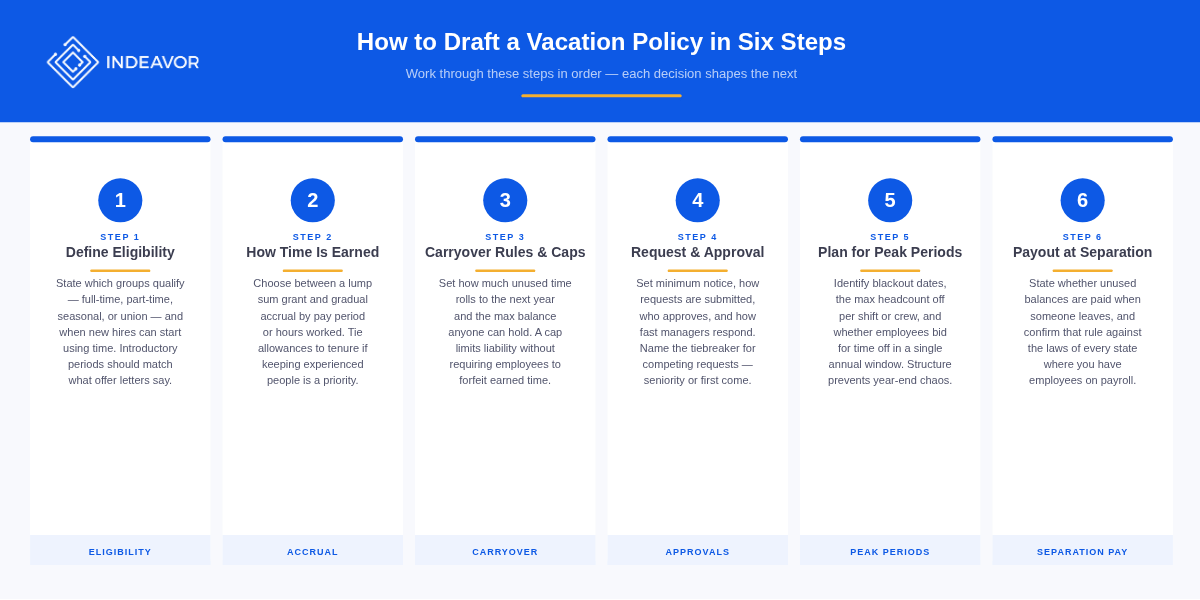
How to Draft a Vacation Policy in Six Steps
A strong policy comes together in six steps. It’s important to work through them in order, as each decision shapes the next.
- Define Eligibility: State which groups qualify, such as full-time, part-time, seasonal, or union employees, and when new hires can start using time. If you use an introductory period, make sure it matches what offer letters promise.
- Determine How Time Is Earned: Decide between a lump sum grant at the start of the year and gradual accrual by pay period or hours worked. Tie allowances to tenure if keeping experienced people is a priority.
- Set Carryover Rules and Caps: Specify how many unused vacation days roll into the next year and the maximum balance anyone can hold. A cap limits financial exposure without asking people to forfeit time they already earned.
- Write the Request and Approval Process: Include minimum notice, how requests are submitted, who approves them, and how quickly managers must respond. Name the tiebreaker for competing requests, such as seniority or first come, first served.
- Plan for Peak Periods: Identify blackout dates, the maximum number of people off per shift or crew, and whether employees bid for annual time off in a single window each year. A structured time off bidding process prevents the scramble that so often drags into the new year.
- Document Payout at Separation: State whether unused balances are paid when someone leaves and confirm that rule against the laws of every state where you have employees.
Test the policy against your schedule before you publish it. In practice, the most common failure is not weak policy language. It is a gap between what the policy allows and what the operation can absorb. If the rules permit four people off per crew, but a line needs nine of its ten operators to run, supervisors will quietly override the policy, and quickly eroding trust.
Before you finalize the policy, pull last year’s requests, overlay your minimum staffing levels, and flag the weeks where the draft rules would have created conflict. Our guide to managing holiday vacation planning and time off requests walks through how to handle overlap during the busiest stretch of the year.
Finally, treat the employee handbook vacation policy as the single source of truth. Offer letters, manager guidance, and onboarding materials should point back to it rather than restate it in slightly different words. It’s important to have a single source of truth.
Vacation Policy Questions Every HR Team Should Answer
These four questions surface in almost every policy review. Answer each one directly in your employee vacation policy so managers are not left to improvise. Vacation rules vary by state, so treat what follows as a starting point and confirm the details with employment counsel.
Can an employer take away earned vacation time?
In many cases, no. Several states, including California and Colorado, treat earned vacation as wages, which means it cannot be forfeited through a “use it or lose it” rule. Other states permit forfeiture as long as the policy states it clearly and in advance.
What employers can generally do is control future earnings. A balance cap is the compliant middle ground: once an employee reaches the ceiling, they stop earning until they take time off. That keeps liability predictable and nudges people to actually rest, which is the whole point of the benefit.
Do part time employees get paid time off?
Not according to federal requirements. The U.S. Department of Labor confirms that the Fair Labor Standards Act does not require pay for time not worked, so paid vacation is a matter of agreement between employer and employee. However, many state and local paid sick leave laws do cover part-time workers, so they may be owed some paid leave even if vacation is excluded.
If you include part-time staff, prorating is the cleanest approach. Someone scheduled for 20 hours a week would earn vacation days at half the full-time rate. In frontline environments where flexible talent is hard to replace, a prorated benefit is often a low-cost retention lever.
How does vacation accrual work?
Accrual means employees earn time off gradually, usually per pay period or per hour worked, rather than receiving it all at once. For example, an employee eligible for 120 hours a year and paid biweekly accrues roughly 4.6 hours each paycheck.
The two most common models:
- Per Pay Period: Predictable and easy to communicate. Balances grow on a fixed schedule regardless of overtime.
- Per Hour Worked: Fits variable schedules and part-time roles, since time off tracks actual hours.
Lump sum grants are simpler, but they create exposure if a new hire uses a full year of time in the first quarter and then resigns. Accrued vacation also sits on the balance sheet as a liability, which is why finance leaders care about vacation caps and PTO payout rules as much as HR does. Bring finance into the drafting process early to avoid rework later.
Can an employer change the vacation policy without notice?
Employers can usually change a vacation policy going forward, especially when the handbook reserves that right. Doing it without notice, however, is a mistake, and three limits apply:
- Time already earned generally cannot be taken away in states that treat vacation as wages.
- Changes affecting employees under a collective bargaining agreement usually must be negotiated with the union.
- Individual employment contracts may lock in specific terms.
When a change is necessary, give written notice well ahead of the effective date, protect existing balances, explain the business reason, and collect signed acknowledgments. How you roll out a change matters as much as the change itself. A reduction announced in a single-paragraph email will read as a pay cut, because to employees it is one.

Make Your Vacation Policy Work as Hard as Your Schedule
An employee vacation policy is more than a benefits document. It is an operating rule that determines whether coverage holds, whether managers make consistent decisions, and whether employees trust that their annual time off will actually be honored.
Define eligibility, accrual, carryover, approvals, peak periods, and payout in plain language. Answer the hard questions before employees ask them. Then test every rule against real staffing data so the policy and the schedule tell the same story.
The final step is execution. When requests live in paper forms and email threads, even a clear policy breaks down. Indeavor’s Annual Vacation Planning module lets employees select their annual time off while scheduling rules protect coverage, with every approval and balance visible in one place. If you are ready to see how that would work in your operation, request a demo and talk with our team.
Share this post