

When an employee gets sick, or something unexpected keeps them from their shift, someone on your team has to scramble to find coverage. What’s your current strategy for handling that moment?
For a lot of frontline organizations, it’s still a manager working through an employee directory, dialing numbers until someone picks up. Others have moved to position-specific lists, but those lists often go stale, with outdated certifications or employees who left the company months ago. A strong call out process fixes this before it becomes a daily fire drill, and it works better when it serves both the employee reporting the absence and the manager who has to cover it.
What Does It Mean to Call Out of Work?
Calling out means an employee notifies their employer they can’t make a scheduled shift, usually with little notice. It’s different from PTO or planned sick leave, which are scheduled in advance, and different from a no-call/no-show, where an employee simply doesn’t show up or communicate at all.
In salaried office roles, a missed day rarely disrupts operations. In frontline, shift-based work like manufacturing, healthcare, energy, and public safety, one call out can leave a critical position uncovered. That’s why the process around it matters so much more.
Why the Call Out Process Breaks Down
Most call out problems come down to a few recurring issues. Manual channels like texts, phone chains/trees, or group messages create delays and confusion about who’s actually covering a shift. There’s often no clear owner of the confirmation step, so managers are left guessing whether coverage is locked in. Policies get enforced inconsistently across shifts and supervisors, and without accurate tracking, organizations open themselves up to compliance and grievance risk.
You Need a Proactive Call Out Plan
The biggest issue with absence management is that most companies only think about coverage after a vacancy happens. A better approach builds the plan before the call out ever comes in.
That starts with pre-configured lists of qualified employees for each position, built around your organization’s own rules. Instead of a static list, you can sort by overtime hours, seniority, scheduling preferences, work patterns, or any other variable that matters to your operation. When an employee call off happens, the right list is already there, and the right, qualified employee is one click away.
This same data also supports better overtime management. Manufacturing operations in particular tend to struggle with overtime overages, and having accurate, filterable call out data helps distribute OT hours fairly and in line with union or work rules, which can meaningfully reduce cost over time.
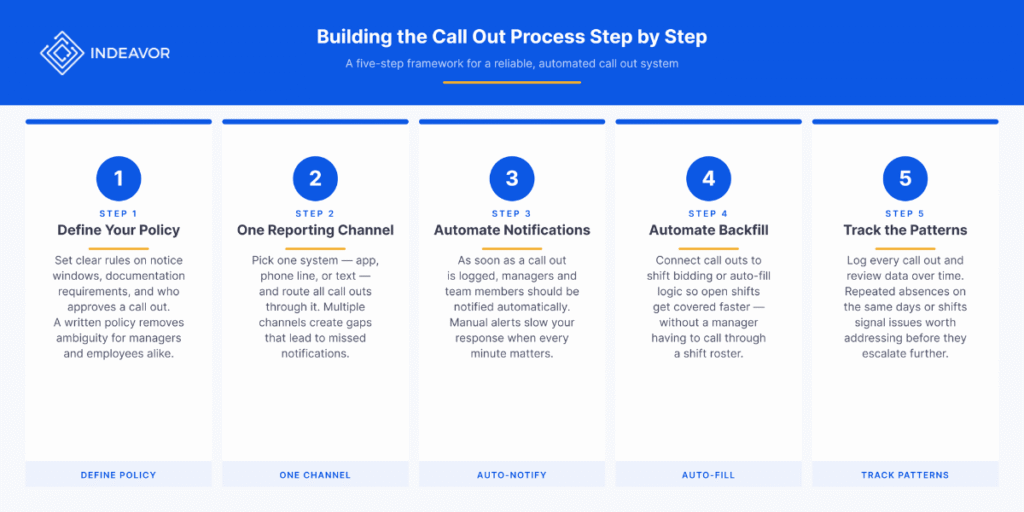
Building the Process Step by Step
- Define your call out policy, including notice windows and required documentation
- Choose a single reporting channel so employees and managers aren’t juggling multiple systems
- Automate manager and team notifications the moment a call out is logged
- Build in automatic backfill or shift bidding so open shifts get filled faster
- Track call out patterns over time to catch attendance issues before they escalate
How to Call Out of Work (The Employee Side)
None of this works if the employees still do not know how to call off work. A smooth call out, from an employee’s perspective, means one clear channel to report an absence, a fast confirmation that it was received, and no guesswork about what happens next. Employees shouldn’t need to know your internal escalation process. They just need a simple way to report an absence and trust that it’s handled.
The Role of Technology
Modern scheduling platforms bring these pieces together. Employees can report a call out through self-service tools, managers get real-time visibility into coverage gaps, and shifts that don’t fill automatically escalate to the right backup. This is the idea behind putting the Right Person in the Right Place at the Right Time, and it’s what turns call outs from a daily scramble into a manageable, predictable process.
Increase Auditability
Digitizing the call out process also solves a problem paper and spreadsheets never could: auditability. Every call, every response, and every outcome can live in one searchable, cloud-based record. Some systems can even freeze employee data at the moment a call out starts, so the log stays accurate and traceable no matter when someone looks back at it.
With paper or spreadsheets, you can track individual responses, but you lose the pattern across jobs. You might not notice that the employee you keep leaving voicemails for always claims they never received one. A centralized log makes that pattern visible immediately.
It also protects you. If a union grievance claims an employee was never offered overtime, you can pull up the record and confirm exactly who was called, when, and how they responded.
See How Indeavor Replaces the Phone Tree
If your team is still working through a phone tree, a group text chain, or a spreadsheet every time someone calls out, you’re not alone, and you don’t have to stay there. Indeavor replaces that manual scramble with a single system that logs the call out, notifies the right manager, and surfaces qualified employees for backfill automatically.
This is a good fit if you’re managing shift-based staffing across one or more locations, dealing with union or overtime rules that make manual tracking risky, or simply tired of the same phone tree breaking down every time someone’s out. If that sounds like your team, schedule time to see how Indeavor handles call outs, no obligation, just a look at how the process could work for your organization.

FAQ
What’s the difference between calling out and a no-call/no-show?
A call out includes communication before the shift; a no-call/no-show means the employee didn’t show up or notify anyone.
How many call outs are too many?
This depends on your attendance policy, but most organizations track patterns over a rolling period rather than reacting to a single absence.
Can an employer deny a call out?
Employers can set notice requirements and documentation standards, but outright denying a legitimate absence, especially for illness, carries legal risk depending on your state and industry.
Does calling out affect attendance points or PTO?
In many organizations, yes. Policies vary, so it’s worth confirming how call outs are categorized against your specific attendance and leave policies.
It’s time to move away from separate processes that require re-entering the same information every time someone calls out. The burden of finding coverage shouldn’t fall on one person, and the data from every call out should work for you long after that shift is filled. It’s time for Indeavor.
About the Author
Claire Pieper is the Digital Marketing Specialist for Indeavor. In her role, she specializes in crafting strategic and engaging content, ensuring that customers are well-informed. Claire is dedicated to enhancing the customer experience and optimizing the user journey through Indeavor’s solutions. To learn more or get in touch, connect with Claire on LinkedIn.