




GOVERNMENT AGENCIES · AUTOMATED 24/7 FRONTLINE SHIFT SCHEDULING
Government Agencies Can't Afford Unstaffed Shifts. Or Grievances. Or Audit Findings.
Indeavor automates scheduling for police, fire, corrections, transit, and port operations — enforcing every CBA clause, maintaining minimum staffing mandates, and generating the audit trail that holds up to public scrutiny.
"Indeavor has become a one-stop shop by streamlining internal workflows and combining different processes and applications, resulting in a lot of time saved across multiple work groups."
— John Truong, Xcel Energy
Trusted by the world's most mission-critical enterprises
Avg OT budget overrun in public safety agencies
Avg annual cost of poor labor data quality
Reduction in overtime hours
Fewer scheduling grievances
Why is public sector scheduling different from private sector scheduling?
A staffing gap in a police district, fire station, or corrections facility is a public safety liability rather than an efficiency problem. Minimum staffing mandates carry legal force, public safety bargaining agreements are among the most complex in the country, and every scheduling record is subject to public disclosure.
A staffing gap in public safety isn't an efficiency problem — it's a liability
When a police district goes below minimum staffing, a firehouse runs with half a crew, or a corrections facility falls short on coverage — the agency is exposed. Liability, public scrutiny, union grievances, and potentially tragic consequences all follow. Manual scheduling makes gaps more likely during exactly the moments that matter most: 2 AM call-offs, court appearances, emergencies.
Government CBAs have decades of negotiated complexity
Police, fire, and corrections agreements carry generations of precedent — seniority by badge number, step-down rules, callback procedures, minimum rest requirements, and formal arbitration procedures. Manual scheduling under this level of contractual complexity produces grievances constantly. Every decision is potentially a CBA decision, and every error is documented and contested.
Grant reporting and public records require audit-ready data — always
Federal grant reimbursements (JAG, COPS, FEMA) require documented labor allocation by program. FOIA requests about scheduling decisions can arrive anytime. Union arbitration panels require complete scheduling records. "We'll reconstruct it from emails" is not acceptable to an auditor, an arbitrator, or a federal program officer.
Meet Andre
Andre is a corrections sergeant. He's 41, fourteen years in, and coaches his nephew's youth football team on Saturday mornings. He also drills one weekend a month with the National Guard. Mandatory holdover gets treated like a fact of the job. Most of the time it's a symptom of a schedule built too late to see the gap coming.

What Andre Wants
Enough notice to tell the team whether he'll be at the game. Holdover distributed by the contract, in a rotation he can actually see. His Guard weekends honored without a conversation every single month. And post assignments that match what he's certified to do. It isn't a lot to ask. But for most frontline workers in complex 24/7 operations, it isn't how the system works.
Things happen to you.
Post assignments for next week aren’t out. Andre can’t confirm Saturday with the team.
The facility is two officers short. Andre is held over eight hours. He misses the game and the team runs a sideline without him.
He submits his Guard drill dates for the fourth time this year. They’re on a clipboard somewhere.
Held over again. He has now worked sixteen of the last twenty-four hours on a housing unit.
He’s on the schedule anyway. He sorts it out with two phone calls and a favor, then checks what the sheriff’s office pays.
You have a say.
Post assignments are published in the app. Andre tells the team he’s there for the next four Saturdays.
The system ranks eligible officers by the contract’s equalization rules. Andre can see the rotation and exactly where he sits in it.
His drill dates are entered once and treated as unavailability. He isn’t scheduled against them, and he isn’t asking again every month.
Consecutive-hours limits are applied when the schedule is built, so a double doesn’t turn into an unsafe post assignment.
His certifications are in the system, so he’s assigned to posts he’s qualified for. So is everyone else.
Multiply Andre by every officer in the facility. That is how a 52% reduction in overtime hours happens in an agency that cannot leave a post empty. Minimum staffing gets met because it was planned, not because somebody got held over again.
How does Indeavor handle public sector scheduling complexity?
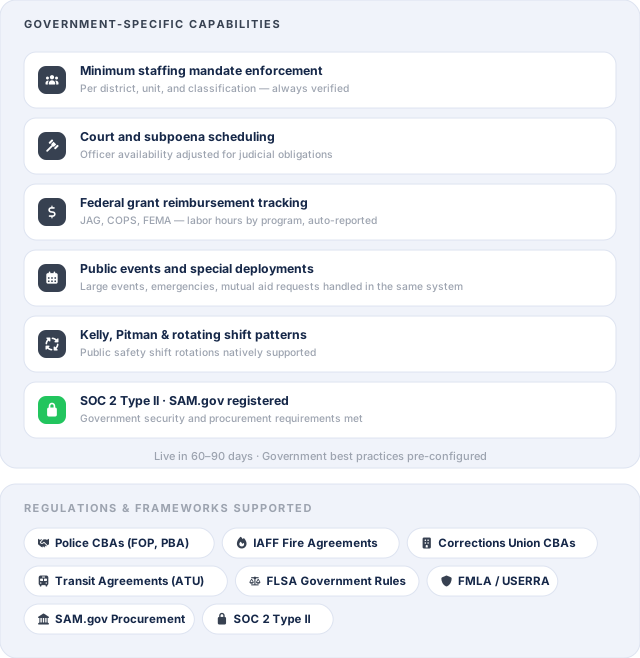
Indeavor enforces minimum staffing mandates before a schedule can be published, applies police, fire, and corrections bargaining rules to every assignment, factors court appearances and special assignments into coverage, and tracks labor hours by grant program for federal reporting.
How does Indeavor enforce minimum staffing mandates?
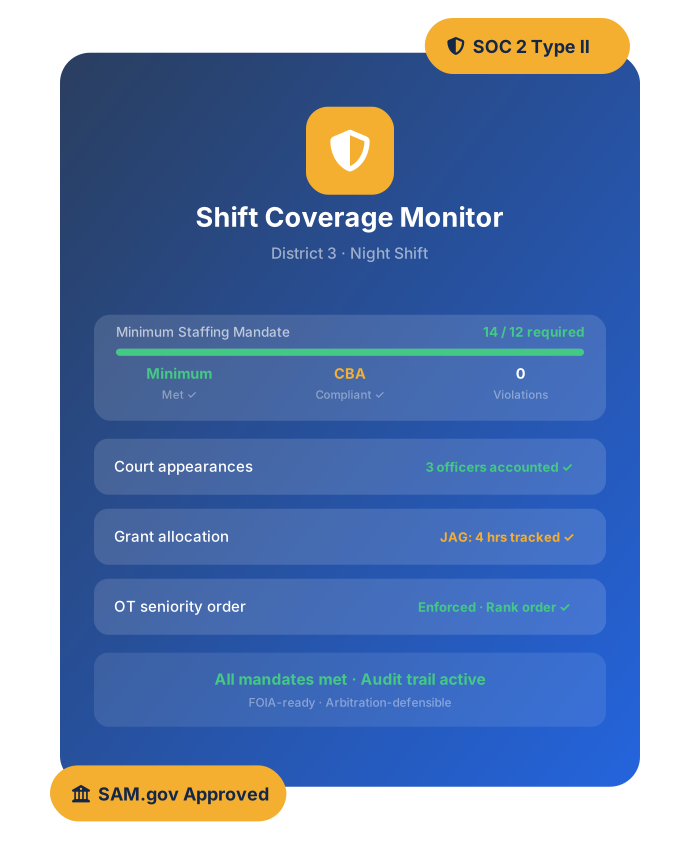
Indeavor enforces minimum coverage at every schedule generation — the schedule cannot be published unless minimums are met. Special assignments, court appearances, and known absences are accounted for before the shift starts, so coverage gaps surface during planning rather than at roll call.
- Mandatory minimums enforced — never bypassed
- Court appearances and assignments factored in
- Automatic backfill when coverage falls short
- Special events and public deployment managed
How does Indeavor handle police, fire, and corrections CBAs?
Every article of every labor agreement is configured once and enforced automatically — seniority by badge number, overtime equalization across ranks, callback procedures, rest period mandates, and vacation bidding rights. Agencies running sixteen simultaneous agreements apply them without manual compliance checks.
- Police, fire, corrections, and transit CBAs supported
- 98% reduction in scheduling grievances
- OT distribution enforced by rank and seniority
- Arbitration-ready audit trail per decision
How does Indeavor support grant reporting and public records requests?
Indeavor captures labor allocation by program, scheduling records for FOIA requests, and complete decision history for union arbitration. Reports are pulled from captured scheduling data, so records do not have to be reconstructed when accountability calls.
- Labor hours tracked by grant program (JAG, COPS, FEMA)
- FOIA-ready scheduling records, always current
- Immutable audit trail per scheduling decision
- Grant reimbursement reports pulled from captured data
Court & Special Assignment Scheduling
Court appearances, depositions, subpoenas, public events, and overtime deployments — all integrated into the scheduling engine for automatic coverage adjustments.
Employee Self-Service (Engage)
Officers, firefighters, and corrections staff see their schedule, swap shifts compliantly, request time off, and volunteer for OT — from the Engage app, all within CBA rules.
Government-Grade Security
SOC 2 Type II certified. Role-based access controls. Data residency compliant. Meeting the security and privacy requirements of federal and state government procurement.
What results do public sector agencies see?
Public sector customers report an average cost savings of $1,641 per employee, 100% staffing compliance, and 10–15 hours reclaimed per supervisor each week. Results vary by agency type, bargaining agreements, and existing scheduling practices.
Average Cost savings
Per employee at a large government agency
Minimum staffing compliance
Mandates enforced before schedule publication
Reclaimed per supervisor / week
Back serving the public, not the spreadsheet
What public sector scheduling
requirements does Indeavor
actually handle?
Indeavor handles minimum staffing mandates enforced before the first shift is published, court dockets integrated into patrol coverage, overtime equalization across ranks and badge seniority, and labor hours allocated by grant program for federal reporting.
-
Public accountability baked in
Government scheduling decisions are public record — subject to FOIA, union arbitration, legislative oversight, and civil litigation. Indeavor's immutable audit trail documents every decision with a timestamp, rule reference, and user — so accountability is built into every shift, not constructed after the fact. -
SAM.gov approved — government procurement ready
Indeavor is registered on SAM.gov, the System for Award Management required for U.S. federal agency procurement. State and municipal agencies with federal procurement requirements can engage with Indeavor through established government contracting channels. -
Live in 60–90 days
Government implementation best practices pre-configured. Common public safety scheduling patterns (Kelly schedule, 4/10, Pitman, fixed rotations) built in. Your specific CBAs and minimums configured without starting from scratch.
Which public sector agencies use Indeavor?
Corrections
Post coverage requirements, classification certifications, corrections officer union agreements, overtime call-back rules.
Police & Law Enforcement
Patrol zones, FOP/PBA agreements, court scheduling, specialized unit deployments, detective and patrol rotation.
Fire & EMS
IAFF agreements, Kelly and Pitman schedules, apparatus coverage mandates, cross-training certifications.
Transit Authorities
ATU agreements, run bid scheduling, operator and maintenance crew management, HOS compliance.
Ports & Authorities
Multi-modal operations, security and operations staff, international trade compliance scheduling. Port Authority NY/NJ customer.
Public Works & Utilities
Water and wastewater operations, streets and sanitation, utilities, CDL requirements, union agreements, on-call rotations, and seasonal demands.
What do public sector customers say?
"Indeavor has become a one-stop shop by streamlining internal workflows and combining different processes and applications, resulting in a lot of time saved across multiple work groups."
— John Truong, Xcel Energy
"It used to take us 3 hours to plan forced OT. With our new Forced OT SGM, it only takes us 45 seconds!"
— Stacie Fischer, Operations Leader
"I love the color coding and schedule view. The ease of scheduling employees is a time saver. The employees learned self service quickly and loved viewing their schedule and requesting time off."
— Allison S., Operations Manager
See Indeavor configured for public sector operations.
Book a 30-minute live demo — minimum staffing enforcement, CBA compliance, court scheduling, grant tracking, and the full audit trail configured for your agency type.
Frequently Asked Questions
Yes. Indeavor is a registered and approved vendor on SAM.gov, the System for Award Management required for doing business with U.S. federal agencies. State and municipal agencies with federal procurement requirements, or those using cooperative purchasing vehicles, can engage with Indeavor through established government contracting channels.
Minimum staffing requirements — whether set by contract, policy, or statute — are encoded into the scheduling engine as hard constraints. The schedule cannot be published unless minimum coverage is met, with all special assignments, court appearances, absences, and training accounted for before the shift starts. When coverage falls short, automated backfill is triggered immediately to find the qualified replacement.
Indeavor encodes every article of your collective bargaining agreements — seniority by badge number or date, overtime equalization across ranks, callback procedures, rest period mandates, vacation bidding rights, bumping rules — into the scheduling engine. These rules are checked automatically on every assignment. When a grievance is filed, the complete audit trail — who was scheduled, in what order, which rule determined the outcome — is available immediately for arbitration defense.
Yes. Indeavor tracks labor allocation by funding source — JAG, COPS, FEMA, and other federal program designations. Hours worked by officers or employees assigned to grant-funded programs are captured automatically with the correct program attribution. Grant reimbursement reports are generated from this data, reducing the manual effort of federal program reporting and providing the documentation required for audit.
Indeavor is SOC 2 Type II certified, meeting the security, availability, and confidentiality standards required for enterprise government deployments. The platform includes role-based access controls, encrypted data transmission, audit logging of all system activities, and data residency options. These controls satisfy the security review requirements of federal and state government procurement processes.
Workforce management software for government agencies schedules public sector staff while enforcing the mandates and agreements that govern them. It applies minimum staffing requirements as hard constraints, honors collective bargaining terms for sworn and civilian personnel, allocates hours to grant programs, and retains a complete record for public disclosure and arbitration.
Yes. Agencies commonly run separate agreements for police, fire, corrections, dispatch, and civilian staff, and each is configured independently in Indeavor. Seniority definitions, overtime equalization methods, callback procedures, and bidding rights can differ by unit while scheduling is managed from one platform.
Court appearances, training, details, and other special assignments are entered as scheduled obligations and factored into coverage before the shift is published. Because these commitments are visible during schedule generation, minimum staffing gaps are identified in planning rather than discovered when an officer is unavailable.
Every shift covered. Every CBA enforced.
Every record ready for scrutiny.
SAM.gov approved. SOC 2 certified. Purpose-built for the scheduling
complexity public sector agencies operate with every single shift.